On this page
- At a Glance
- A Capital of Sixteen Years, Not a Smaller Angkor
- The Ticket and the Gate
- The Sanctuaries Worth the Stops
- The Dancing Shiva: Rebuilt, Unveiled, Still in Siem Reap
- Getting There and the Shape of the Day
- Mines, Paths and the Forest
- Season and Time of Day
- By Situation
- What It Actually Costs
- What Other Guides Get Wrong
- Where to Go Next
- Frequently Asked Questions
Koh Ker is worth a full day for one kind of traveler: the one who has already seen the main Angkor temples and wants a site built on a different idea. For sixteen years in the 10th century it was the capital of the Khmer empire, and its builders left a seven-tiered pyramid in the forest that has no equal anywhere else in Cambodia. It is also 120 km from Siem Reap, two and a half hours each way by car, and that road, not the $15 ticket, is the real price of the visit.
Most pages on Koh Ker either sell it as a quick add-on to Beng Mealea or describe a lost city reached by dirt track. Neither is accurate in 2026. The road is paved, the site has been on the UNESCO World Heritage List since 2023, and the ticket is sold online by the same state company that sells the Angkor Pass. What has not changed is the scale: more than 180 sanctuaries in a protected forest, about two dozen open, and no signs worth the name. The site’s best-known sculpture, the Dancing Shiva rebuilt this year, is not even there.
This guide covers what Koh Ker is, which sanctuaries justify the stops and in what order, the ticket, the car, the season, and how the day fits into the wider list of day trips from Siem Reap. Prices, hours and transport times below were checked against Angkor Enterprise, operator websites and official sources in November 2026.
A Capital of Sixteen Years, Not a Smaller Angkor
The usual way to sell Koh Ker is as “Angkor without the crowds.” That sets the wrong expectation. Angkor is three centuries of capitals built on top of each other around one city plan. Koh Ker is a single short reign, preserved because the court left.
Jayavarman IV moved the royal seat northeast of the Angkor area in 928 and built a new capital, recorded in inscriptions as Lingapura or Chok Gargyar. His son Harshavarman II kept it, and by 944 the capital had returned to the Angkor region. In those years the builders worked fast and at a large scale. Temples went up in brick and in sandstone, statues were carved at a scale rarely attempted before, and the central complex ended in a pyramid rather than a temple-mountain of galleries.
The result is that Koh Ker answers a different question from Angkor Wat. Angkor Wat shows what a mature empire could finish. Koh Ker shows what an ambitious king attempted in a hurry. The UNESCO listing of September 17, 2023 rests on that short, single period.
The second distinction is between kilometers and hours. Koh Ker is in Preah Vihear province, about 120 km from Siem Reap. The road is paved and passes Beng Mealea, but trucks, cattle and village speed limits make it two and a half hours each way by car, sometimes a little more. A day here means five hours in a vehicle. Anyone who has not yet decided how many days Angkor needs should settle that first. Koh Ker belongs on day four or five, never on day two.
The Ticket and the Gate
The $15 Koh Ker ticket
Angkor Enterprise, the state company that runs the Angkor ticket offices, lists a Koh Ker Temples Park one-day ticket at $15. Entry runs from 6:00 a.m. and the site closes at 6:30 p.m. Some third-party guides print 7:30 a.m. to 5:30 p.m., so arriving within those hours is the safe plan. The ticket can be bought online at angkorenterprise.gov.kh or at the booth on the left of the approach road, just before the central car park. Third-party guides in 2025 and 2026 list free entry for children under 12.
The Angkor Pass is not valid at Koh Ker, whether it is the one-day, three-day or seven-day version. That is the main reason a five-day trip that includes Koh Ker can still use the three-day pass at $62, as the 4 to 5 day Siem Reap itinerary explains. Payment at the booth is in dollars. Carry small notes, because change under $1 comes back in riel and a torn note is refused, as covered in money in Cambodia.
What the ticket covers
Angkor Enterprise describes the ticket as covering ten or more accessible temples. Older counts put the open sanctuaries at about two dozen. Both figures are correct in practice: around ten are worth a stop on a first visit, and the rest are small shrines along the same roads. Keep it until the end of the day.
Dress and conduct
Koh Ker is not an active monastery like the pagodas inside Angkor, but the same rule applies as across the park: shoulders and knees covered at the sanctuaries, with no exception for the heat. The Angkor dress code guide has the detail. Treat the lingas and the fallen blocks as part of the monument, not as seats.
The Sanctuaries Worth the Stops
The open temples lie along two roads. The access road from the south passes a string of brick sanctuaries before reaching the central car park. From there a short walk leads to Prasat Krahom and Prasat Thom. A ring road then loops north and east past the linga temples and the edge of the Rahal baray. A driver who knows the site will take them in roughly this order, which puts the climb before the heat.
Prasat Thom and the Prang
The reason to come. Prasat Thom is the central complex, a sequence of enclosures, towers and libraries on an east-west axis, and at its western end stands the Prang: a stepped pyramid of seven tiers, about 36 m high. Nothing at Angkor looks like it. The original stone stairs are closed. In recent years visitors have climbed by a wooden staircase on one side, described in 2025 reports as open and sturdy. Ask the driver or ticket staff whether it is open on the day. Allow 75 to 90 minutes for the complex and the climb. The limitation: the pyramid is fully exposed, with no shade on the stairs or the summit, so from March to May it should be done before 11:00 a.m. or not at all.
Prasat Krahom
Krahom means red, and the name comes from the brick. Prasat Krahom stands beside the entrance to the Prasat Thom complex, a cruciform brick tower in good condition. This is the temple the Dancing Shiva came from, according to the Agence Kampuchea Presse report on its unveiling. The statue is not here, and nothing on site explains it. Allow 20 minutes. The limitation: without a guide or the story of the statue, Krahom reads as one more brick tower.
Prasat Pram
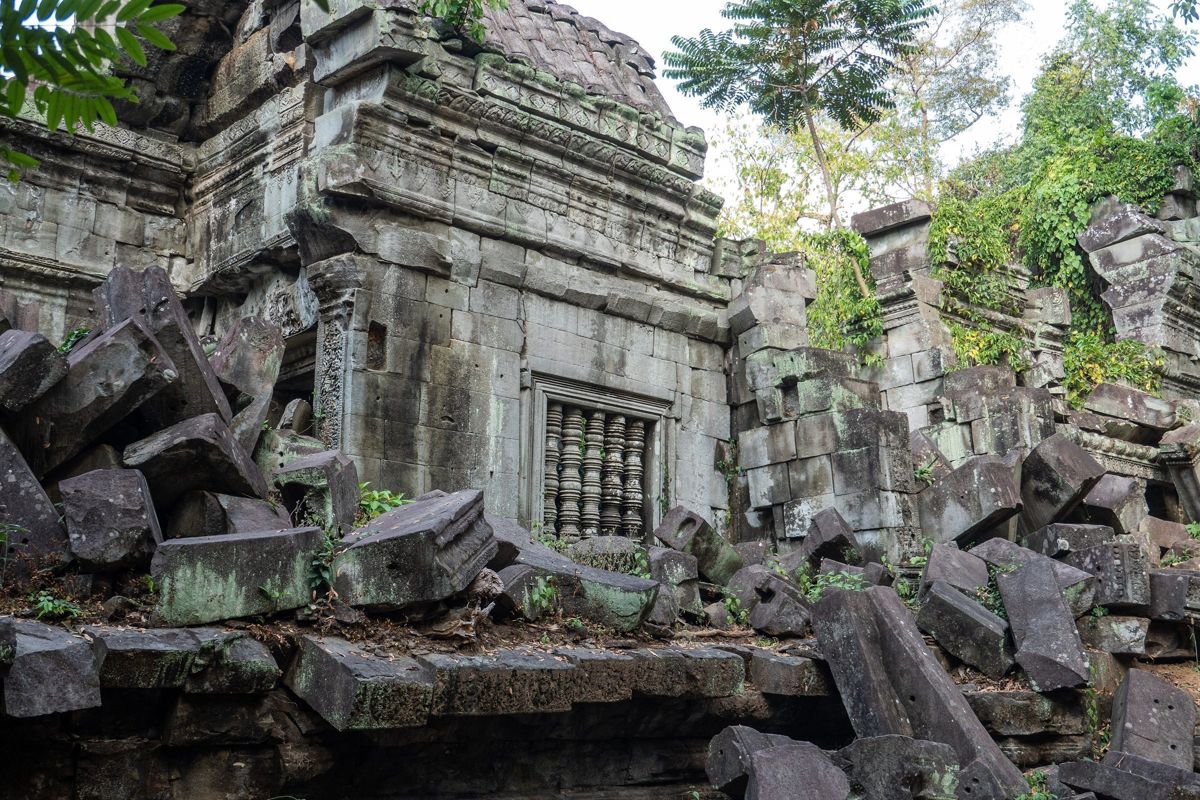
The most photographed stop after the pyramid. Prasat Pram, whose name means “five,” is a small group of brick towers on the access road, gripped by the roots of strangler figs in the way visitors expect from Ta Prohm. It is quiet and shaded, which makes it a good last stop when the sun is high. Allow 15 minutes. The limitation: it is small, and a visitor who has already seen Ta Prohm and Beng Mealea will recognize the effect rather than discover it.
Prasat Neang Khmau
A brick sanctuary on the access road whose name means “Black Lady.” It is a five-minute stop on the way in. The limitation: there is little carving left, and the stop is mostly a photograph.
Prasat Chen and Prasat Bak
Prasat Chen is where the empty pedestals tell the story of the 1970s. Two sandstone warriors from a scene of the Mahabharata, Bhima and Duryodhana, stood here until looters cut them from their feet around 1972. Both reached museums and auction houses abroad and returned to Cambodia in 2014, after a legal case against Sotheby’s and a voluntary return by the Norton Simon Museum. They are now in the National Museum of Cambodia in Phnom Penh. Prasat Bak is a smaller sanctuary on the same road. Together they take 15 minutes. The limitation: what made Prasat Chen important is no longer on site.
The linga temples and the Rahal baray
On the ring road, Prasat Thneng and Prasat Balang are small sanctuaries built around lingas, the stone emblem of Shiva that gave the capital its name. They show how a 10th-century shrine was used more clearly than the larger complexes do. The Rahal baray, a reservoir about 1,200 m by 560 m, lies beside the ring road and is mostly dry outside the rains. The limitation: after the pyramid, many visitors find these stops repetitive. On a short visit, choose one linga temple and skip the rest.
The Dancing Shiva: Rebuilt, Unveiled, Still in Siem Reap
The biggest Koh Ker news of 2026 happened in Siem Reap. On March 18, 2026, the Ministry of Culture and Fine Arts unveiled a Shiva Nataraja, a dancing Shiva with ten arms and five faces, about 5 m tall and 7 tonnes, at the Angkor Conservation Centre in town. The statue came from Prasat Krahom and had been broken into more than 10,000 fragments. Collection and cataloguing began in 2012, and Cambodian specialists working with the École française d’Extrême-Orient (EFEO) spent about five years putting it back together, with funding from the ALIPH Foundation.
The ministry says the statue will be returned to its original site at Koh Ker. No date has been announced and no new building at Koh Ker has been confirmed. An AFP report published on November 10, 2026, during coverage of the French president’s visit to Angkor and the restored West Mebon, described the statue standing in a warehouse near the EFEO center in Siem Reap, almost touching the ceiling, still awaiting the move. No public viewing schedule has been published.
What this means for a visit in 2026 is simple. Do not plan a Koh Ker day around the Shiva. Do read about it before going to Prasat Krahom, because the empty tower makes more sense with the statue in mind. When the return happens, this guide will be updated with the date and the place.
Getting There and the Shape of the Day
By car with driver
The right vehicle and, in practice, the only one. A car with driver for Koh Ker and Beng Mealea in one day starts at about $95 for the vehicle on 2026 operator rates, with the wait included. A van for a larger group costs more. Air conditioning on a five-hour round trip changes how the afternoon feels. The limitation: a driver is not a guide, and at a site with no signage the difference matters more than at Angkor. Tuk-tuk, car or bike explains how drivers price by destination.
With a licensed guide
A licensed guide adds more at Koh Ker than at Angkor Wat, because the site explains almost nothing itself. One Siem Reap guide agency lists English-language guides at $40 a day with a $15 supplement for Koh Ker, and other languages cost more. The reasoning in hiring an Angkor guide applies: one guided long day is often worth more than a guided morning at a temple with good signs. The limitation: the guide rides in the car for five hours, so book a car with room for one more.
By tuk-tuk or motorbike
Not sensible. A tuk-tuk to Beng Mealea alone is already 90 minutes or more each way in the open. Koh Ker doubles that, and the return would run into the dark. Drivers do not usually offer it, and the ones who do will price it close to a car.
The usual day, hour by hour
- 7:00 a.m.: leave Siem Reap.
- 9:30 a.m.: ticket booth and Prasat Thom, with the pyramid climb first.
- 11:00 a.m.: Prasat Krahom, then the ring road or the access-road sanctuaries.
- 12:00 p.m.: lunch at the stalls behind the central car park, or leave and eat on the road.
- 1:00 p.m.: Beng Mealea on the way back, when its forest shades the walkway.
- 4:00 p.m.: back in Siem Reap.
Leaving at 6:00 a.m. instead puts the pyramid in softer light and shortens the hot part of the day. Coming back after 6:00 p.m. is the one thing to avoid: the road has unlit trucks, motorbikes and cattle, and night driving is the real risk of the trip. The is Siem Reap safe guide covers road risk in general.
Food, water and toilets
Simple restaurants and drink stalls stand behind the central car park. There are no vendors inside the temple enclosures. Bring water from town, more than seems necessary, and a hat. What to pack for Siem Reap lists the rest.
Mines, Paths and the Forest
Koh Ker sits in a protected forest that is not fully cleared of mines and unexploded ordnance. The visitor paths, the roads and the open sanctuaries are. The rest of the area, including many of the 180 or so sanctuaries that are not open, is not guaranteed. This is not a reason to stay away. It is a reason to stay on the marked paths, never to walk into scrub or across a field to reach an unmarked ruin, and to refuse anyone who offers a shortcut to a “secret temple.” Children should be kept on the paths. The history behind the warning is laid out in the Landmine Museum and APOPO guide, which is a useful afternoon in town before or after the trip.
Season and Time of Day
From November to February the road is dry, the mornings are cool and the pyramid climb is comfortable until late morning. This is the best window. From March to May temperatures above 35°C are common, and the exposed Prang should be climbed before 11:00 a.m. From June to October the paved road stays open, but the dirt tracks between the outlying sanctuaries turn to mud and some flood, and the Rahal baray fills with water. The rainy season guide covers what that means across the region, and the best time to visit Siem Reap has the month-by-month picture.
Koh Ker is rarely crowded at any hour. The reason to arrive early is heat, not people.
By Situation
You have three days or fewer
Skip Koh Ker. The main park, Banteay Srei and perhaps Phnom Kulen will fill three days better than five hours in a car.
You have four or five days and have seen the main temples
Give Koh Ker and Beng Mealea one day, leaving at 7:00 a.m. It is the most rewarding long day from Siem Reap, and the three-day Angkor Pass still covers the rest of the trip.
You are interested in sculpture and history
Hire a licensed guide for the day, read about the Dancing Shiva and the Prasat Chen warriors before going, and plan a stop at the National Museum of Cambodia if the trip continues to Phnom Penh.
You are traveling with children
Possible in the cool months with a car. The pyramid climb suits children who are steady on stairs, and Prasat Pram’s roots are the part they remember. Keep them on the paths.
You are visiting in April
Leave at 6:00 a.m., climb the Prang first, and be back in the car by 11:30 a.m. Beng Mealea, shaded by its forest, is the better half of the day in this month.
What It Actually Costs
| Item | Price | Notes |
|---|---|---|
| Koh Ker ticket | $15 | One day, Angkor Enterprise. Angkor Pass not valid. |
| Beng Mealea ticket | $10 | One day, if combined. |
| Car with driver, Koh Ker and Beng Mealea | From about $95 | Per vehicle, wait included. |
| Licensed guide, English | About $40 plus a $15 Koh Ker supplement | One agency’s published rates. Other languages cost more. |
| Lunch at the car park restaurants | Prices not posted online | Cash in dollars or riel. |
| Driver’s tip | $3 to $5 | Customary after a long day. See tipping in Cambodia. |
For two travelers sharing the car, the day comes to about $75 each with tickets and a tip, before a guide. For four, the car cost per person falls by half. What is not included anywhere: water, which costs more at the stalls than in town, and the time, which is nine hours door to door.
What Other Guides Get Wrong
- Calling Koh Ker a smaller Angkor. It is a different capital of a single period, and its centerpiece is a pyramid, not a temple-mountain of galleries.
- Giving the distance and not the time. 120 km reads like a morning. It is two and a half hours each way, and the day takes nine hours.
- Writing that the Angkor Pass covers it. It does not. Koh Ker has its own $15 ticket, sold online and at the booth.
- Describing a dirt road and a lost city. The road is paved all the way, and the site has been on the UNESCO list since September 2023.
- Sending visitors to see the Dancing Shiva at Koh Ker. The statue was unveiled in Siem Reap in March 2026 and, as of November 2026, has not returned.
- Ignoring the mines. The paths are cleared and the forest is not. Staying on them is the rule.
Addresses, hours, prices and transport times checked against operator websites and official sources in November 2026. Hours change seasonally and prices change often. Confirm anything time-critical with the operator.
Where to Go Next
Koh Ker is the farthest of the trips ranked by road time in day trips from Siem Reap, which is the place to decide whether it beats Phnom Kulen or the lake for a spare day. The temple it is almost always paired with is Beng Mealea, and the ticket rules for both sit in the Angkor Pass guide. For the shape of a longer trip that includes it, read the 4 to 5 day Siem Reap itinerary, and for the other restoration making news this month, West Mebon and the West Baray.
Addresses, hours, prices and transport times checked against operator websites and official sources in November 2026. Hours change seasonally and prices change often. Confirm anything time-critical with the operator. Found an error? Tell us and the guide's review date will be updated.
Frequently Asked Questions
Is Koh Ker worth the trip from Siem Reap?
Worth it for anyone who has already seen Angkor Wat, the Bayon and Banteay Srei and wants a site that looks like none of them. The seven-tiered Prang is the only pyramid of its kind in Cambodia, and the brick sanctuaries in the forest around it see a fraction of Angkor's visitors. Not worth it on a two- or three-day trip, because the cost is five hours in a car for about three on site. Paired with Beng Mealea on the way back, it is the most rewarding long day from Siem Reap, at about $95 for the car and $25 in tickets.
How much is the Koh Ker ticket in 2026?
Angkor Enterprise lists a Koh Ker Temples Park one-day ticket at $15, with entry from 6:00 a.m. and closing at 6:30 p.m. It can be bought online at angkorenterprise.gov.kh or at the booth on the approach road before the central car park. The Angkor Pass is not valid at Koh Ker, so even a seven-day pass holder pays the $15. Third-party guides in 2025 and 2026 list free entry for children under 12. Carry small dollar notes, because change under $1 comes back in riel.
Can you climb the Koh Ker pyramid?
The original stone stairs of the Prang are closed, and visitors have reached the top in recent years by a wooden staircase on one side. Reports from 2025 describe it as open and sturdy, but Angkor Enterprise publishes no daily status, so ask the driver or the ticket staff on the day. The climb is about 36 m, steep and fully exposed. Do it before 11:00 a.m. from March to May.
Can you do Koh Ker and Beng Mealea in one day?
Yes, by car, and it is the standard way to see Koh Ker. Leave Siem Reap at 7:00 a.m., drive straight to Koh Ker for about 9:30 a.m., spend two to three hours there, then stop at Beng Mealea on the way back around 1:00 p.m., when its forest canopy shades the walkway. Back in town around 4:00 p.m. Tickets are $15 and $10. A car with driver starts at about $95 on 2026 operator rates. A tuk-tuk cannot sensibly do this day.
Where is the Dancing Shiva from Koh Ker now?
In Siem Reap, not at Koh Ker. The statue, about 5 m tall and 7 tonnes, came from Prasat Krahom and was shattered into more than 10,000 fragments. Cambodian specialists working with the EFEO reassembled it, and the Ministry of Culture unveiled it at the Angkor Conservation Centre in Siem Reap on March 18, 2026. An AFP report of November 10, 2026 describes it standing in a warehouse near the EFEO center, awaiting its return. The ministry says it will go back to Koh Ker, but no date or public viewing schedule has been published.
Is Koh Ker safe from landmines?
The visitor paths are, and the rest of the area is not fully cleared. Koh Ker lies in a large protected area where only about two dozen of more than 180 sanctuaries are open, and mine clearance has not covered all of the forest between them. The rule is simple: stay on the marked paths and the tracks the driver uses, do not walk into scrub to reach an unmarked ruin, and do not follow a stranger offering a shortcut. Visitors who keep to the open temples are on ground walked by thousands of people a year.
When is the best time to visit Koh Ker?
November to February. The roads are dry, the mornings are cooler and the light on the Prang is clear until late morning. March to May is hot, often above 35°C, which makes the open pyramid climb and the walks between sanctuaries hard after 11:00 a.m. From June to October the main road stays usable, but the tracks between the outlying sanctuaries turn to mud and some flood, and the Rahal baray fills. Arrive early in any month to beat the heat, not the crowds, because Koh Ker is rarely busy.
More Day Trips & Beyond Angkor guides
Start with the pillar guide: Day Trips from Siem Reap: Which Ones Work in a Day and What Each Really Costs (2026).
-
-
-
-
-