On this page
- At a Glance
- The Trap: It Is a Water Monument, Not Another Temple-Mountain
- Is West Mebon Open Now?
- What There Is to See
- A Short History of the Reservoir and the Temple
- Getting There
- When to Go
- Rules and Dress
- By Situation
- What It Actually Costs
- What Other Guides Get Wrong
- Where to Go Next
- Frequently Asked Questions
West Mebon is the one Angkor temple whose story changed this month, and the honest way to see it is a short boat ride on a third or fourth day, not a detour on the first. After about 14 years of restoration by the French school EFEO and the APSARA National Authority, the 11th-century island temple in the middle of the West Baray is being handed back with a ceremony during French President Emmanuel Macron’s state visit to Cambodia, on November 14 to 16, 2026.
Most of what is online about West Mebon is either a decade old, from when the site was a scaffolded ruin, or written for the news, about the restoration and the diplomacy. Neither answers what a traveler needs: whether the temple is open, how the boat works, whether the Angkor Pass applies and what there is to see now that the famous bronze Vishnu is in a museum abroad. Some of those answers were not yet published at the time of checking, and this guide says so where that is the case. It sits under the Angkor Pass guide, which sets the ticket rules for the whole park.
Prices, hours and transport times below were checked against operator websites and official sources in November 2026.
The Trap: It Is a Water Monument, Not Another Temple-Mountain
The word “temple” sets up the wrong expectation. West Mebon is not a pyramid like Pre Rup or a gallery temple like Angkor Wat. It is a square enclosure of about 100 m per side on an artificial island, with tower gateways in its walls and a pool in the center. There is no central sanctuary to climb. The point of the building was the water around it.
That water is the West Baray, a reservoir about 8 km long and 2 km wide, dug in the 11th century and still in use for irrigation. APSARA puts its capacity at about 56 million cubic meters. The temple stood at its center, and inside the temple a pool held a giant bronze Vishnu reclining on the cosmic ocean. The whole composition was a statement about kingship and water, and it still reads that way from a boat.
So the visit is short and the setting is the experience. Travelers expecting carvings on the scale of Banteay Srei or faces like the Bayon will be disappointed. Travelers who want to understand why Angkor was built where it was, and what a baray was for, will find no clearer example.
Is West Mebon Open Now?
The ceremony and the opening
Cambodia’s Foreign Ministry announced on November 9, 2026 that Emmanuel Macron will make a state visit from November 14 to 16, alongside the 20th Francophonie Summit in Phnom Penh. The program includes a trip to Siem Reap, where the French president and King Norodom Sihamoni are to preside over the ceremony closing the West Mebon restoration. Cambodian press reports in October described it as the opening of the temple to the public in November 2026.
The exact day of the Siem Reap ceremony had not been published as of November 11. A state visit of this kind brings security perimeters and road closures, and none had been announced at the time of checking. The honest verdict: do not plan West Mebon, or any visit on the west side of the park, for November 14 to 16.
What was not yet published
APSARA and Angkor Enterprise had not published opening hours, ticket rules or boat arrangements for the reopened temple as of November 11, 2026. Reports from mid-October described APSARA staff still clearing the grounds, while some visitors were already crossing to the island by boat. This guide will be updated when the rules appear. Until then, ask a licensed Angkor guide or a tuk-tuk driver the day before.
What There Is to See
The restored enclosure
The reason to go is to see a monument that was close to collapse standing again. The enclosure walls carried tower gateways, about 28 m apart along each side, and most had fallen into the water or the sand before the project began. APSARA reported nine of the twelve towers standing again in November 2022. Around 140 workers, mostly Cambodian stonemasons, rebuilt them by anastylosis: taking each structure apart, numbering the stones and putting them back on new foundations, with a temporary dam keeping the site dry during the work.
Inside the walls are the remains of a small central pool and island, and a well where the bronze was found. A raised causeway leads toward the platform where the Vishnu once lay. APSARA said in 2025 that artifacts that could not be put back would be displayed on the site. No details of that display had been published as of November 11.
A visit takes 45 minutes to one hour. The island has no shade beyond the walls.
The missing Vishnu
The bronze Reclining Vishnu is the reason West Mebon is famous, and it is not there. Found in 1936 by French archaeologists, the surviving fragment, a head, shoulders and two right arms, is the largest bronze known from Angkor. A complete figure would have been about 6 m long. It belongs to the National Museum of Cambodia in Phnom Penh.
The statue left Cambodia for conservation in France in 2024 and was shown at the Guimet museum in Paris in 2025, then in Minneapolis and Washington. It is on display at the Asian Art Museum in San Francisco from October 23, 2026 to January 25, 2027. APSARA’s director general said in 2025 that a return to the island would be very hard to promise and that a replica or projection had been discussed.
The West Baray itself
The reservoir is the one place near Angkor where Siem Reap families go to swim. On weekends the south dike, toward its western end, fills with picnic huts, hammocks, food stalls and inner tubes for rent. Travel guides describe the beach as free, with no Angkor Pass check. There is no lifeguard and no published water-quality testing.
The remains of Ak Yum, an earlier temple partly buried in the south dike when the reservoir was built, are passed on the road in. Little of it is visible.
A Short History of the Reservoir and the Temple
Building the West Baray
The West Baray is the great Angkor reservoir that still holds water, unlike the dry East Baray. It measures about 7.8 km by 2.1 km, with earth dikes close to 12 m high and an average depth of about 4 m. Work probably began in the 11th century under Suryavarman I and was finished under Udayadityavarman II, who reigned from 1050 to 1066. Inscriptions are not clear on the dates, and an excavation in 2010 suggested the work took about 50 years.
The site was not empty before. Ak Yum, one of the earliest temple-mountains in the region, was partly buried by the south dike. In 2005 archaeologists found a burial site about 500 m from West Mebon, at Koh Ta Meas, roughly 3,000 years old. The reservoir sits on land that people had used for a very long time.
The temple and its first visitors
West Mebon was built in the middle of the 11th century and dedicated to Vishnu. The Chinese envoy Zhou Daguan, who spent a year at Angkor at the end of the 13th century, described the island temple and its bronze figure, though he took the Vishnu for a Buddha.
The French conservator Maurice Glaize worked on the site from 1942 to 1944. The bronze had been recovered in 1936 from the well at the center of the temple. For most of the following decades the walls slid into the water and sand, and the eastern side was close to collapse when the current project began.
The 2012 to 2026 restoration
The EFEO team moved to West Mebon in 2012, after finishing the restoration of the Baphuon in Angkor Thom in 2011. The work was funded by the French government and carried out with APSARA, under the technical lead of Cheam Pross. Artisans Angkor trained craftspeople for the stone work, with support from the heritage foundation ALIPH from 2023 to 2025. The project was meant to finish by 2016 and took ten years longer. The same partnership of EFEO and Cambodian specialists rebuilt the Dancing Shiva of Koh Ker from more than 10,000 fragments, unveiled in Siem Reap in March 2026.
APSARA expects the rebuilt eastern section to stand for 50 to 150 years with regular maintenance. That figure is the reason for the care taken over foundations, which had to resist a reservoir that rises and falls by several meters each year.
Getting There
By tuk-tuk to the south dike
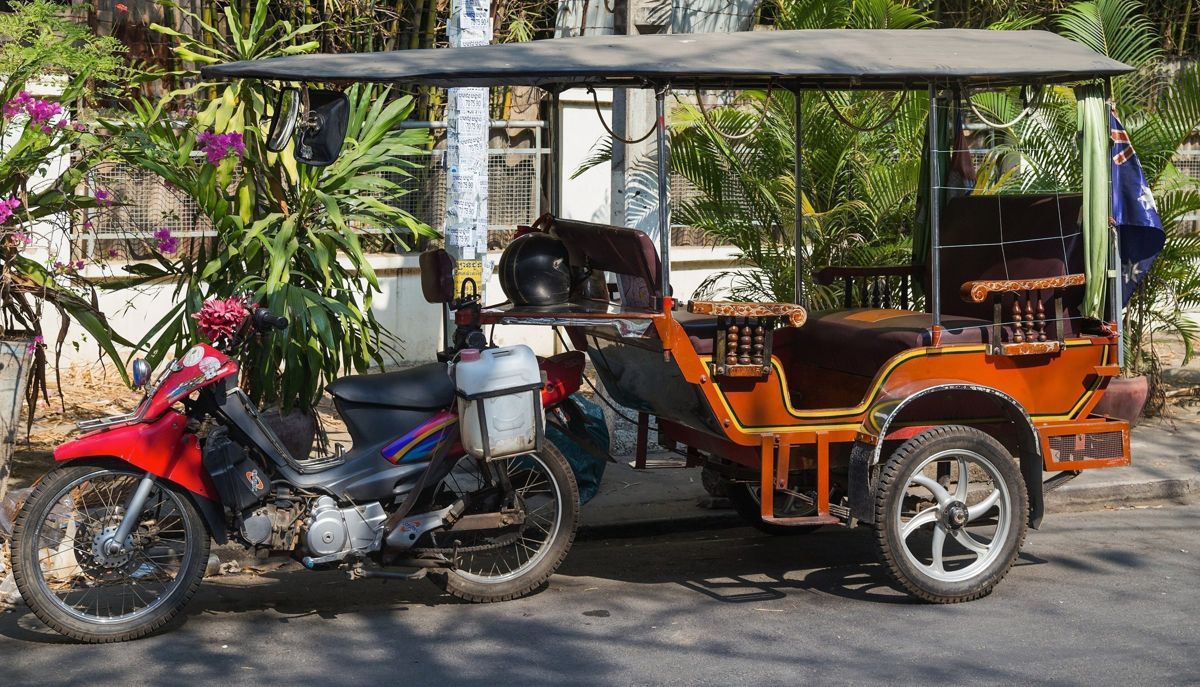
The usual route runs west from town to the south dike, where the boats wait. A tour operator guide updated in May 2026 gives 30 to 45 minutes from Siem Reap. There is no official fare. Town fares run $2 to $3, and a ride out to the West Baray and back with waiting time is a negotiation, so agree a round-trip price before leaving. The simplest option is to add the reservoir to a day already booked with a driver, as set out in the tuk-tuk, car and bike guide. Cyclists can reach it on flat roads in the cool hours.
By boat to the island
The boats are local wooden boats at the south dike. Visitor reports, undated, give $15 to $20 per boat for the short crossing, with room for a family. A separate small charge per group is mentioned in one older report. Agree the price, the waiting time on the island and the last return before getting in.
On foot in the dry season
The reservoir drops for about three months a year, usually late in the dry season. When the water is low enough, the island can be reached on foot across the exposed bed. In November, after the rains, the water is high and the boat is the only way across. Closed shoes help in the dry months.
When to Go
Time of day
Early morning is best, from about 7:00 a.m., before the light on the open water turns harsh. The crossing and the island have no shade, so be back on the dike by 11:00 a.m. from March to May. Late afternoon is the second choice. Sunset over the reservoir is the reason some visitors come, but boats may stop before dusk. The temple-by-temple timing is set out in the best time of day for each Angkor temple.
Season
In the rainy season and the months after it, the temple stands as an island in a full reservoir, which is how it was designed to be seen. APSARA says the water recedes significantly for about three months a year, in the late dry season, and the setting is then flatter. December and January bring the most visitors to Angkor, but West Mebon was rarely crowded even then. That may change in its first weeks after the reopening.
Rules and Dress
West Mebon is a temple inside the Angkor heritage site. Shoulders and knees must be covered, as set out in the Angkor dress code. Do not climb, sit or lean on the restored walls or towers. Drones need prior written APSARA permission, as everywhere in the park. The beach on the dike is not a temple, but it is a family place, and modest swimwear is the norm.
The site is not suited to travelers with limited mobility. The boats are boarded from the bank, and the island has uneven stone and steps.
By Situation
You have one or two days at Angkor
Skip it. Angkor Wat, the Bayon and Ta Prohm come first, and the small circuit and grand circuit already fill two days. The answer to how many days Angkor needs puts West Mebon in the third day or later.
You have a three-day or seven-day pass
Add the West Baray to the morning of the third day or to a slower afternoon. It fits with the sunset spots on the west side of the park. Phnom Bakheng looks west over the reservoir.
You are traveling with children
The boat ride is the attraction for most children, and the visit is short. Combine it with an hour at the dike for the hammocks and the water, and keep them out of the midday sun. More ideas are in Angkor with kids.
You are here for the ceremony week
The temple is unlikely to be accessible to visitors on the day of the ceremony, and roads in the west of the park may close. Go after November 16. Siem Reap’s Water Festival runs on the river from November 20 to 25, with boat races scheduled on November 23 and 24.
You care about Angkor’s water system
West Mebon is the key site for it. Pair it with the East Mebon, which stood in the now-dry East Baray, and with the Tonle Sap lake guide for the lake that fed the whole system.
What It Actually Costs
| Item | Cost | Notes |
|---|---|---|
| Angkor Pass, one day | $37 | Three-day $62, seven-day $72. Children under 12 free with a passport |
| Boat to the island | $15 to $20 per boat | Undated visitor reports. Agree before boarding |
| Tuk-tuk from town | Negotiated | Town fares $2 to $3. Add to a day already booked |
| Beach on the south dike | Free | Pay vendors for food, drinks, hammocks and inner tubes |
| Licensed guide, half day | Part of a $40 day rate | English-speaking guide rate per day |
The boat price is the one figure that may change after the reopening. Pay in dollars, and expect small change in riel. Torn notes are refused. Bring water from town.
What Other Guides Get Wrong
- They place the Vishnu at the temple. The bronze is in a museum, currently on loan to San Francisco until January 25, 2027.
- They describe West Mebon as a ruin under scaffolding. That was true for most of the 2010s. The restoration ends in November 2026.
- They treat it as a full temple stop. It is an enclosure of about 100 m per side with no sanctuary to climb. The visit takes under an hour.
- They give one way to reach it. The boat is the way across in November. Walking across the bed is possible only when the water drops, late in the dry season.
- They say no pass is needed. That is true for the beach on the dike. Travel guides say the pass is checked for the island temple, and new rules have not yet been published.
- They call the West Baray dry. The west part of the reservoir holds water year-round and still irrigates rice fields to the south.
Addresses, hours, prices and transport times checked against operator websites and official sources in November 2026. Hours change seasonally and prices change often. Confirm anything time-critical with the operator.
Where to Go Next
West Mebon fits a longer visit, so start with the Angkor Pass guide to choose a pass, then the three-day Siem Reap itinerary to see where a reservoir morning fits. The Angkor sunset spots cover the west side of the park, and what to pack covers the sun on open water.
Addresses, hours, prices and transport times checked against operator websites and official sources in November 2026. Hours change seasonally and prices change often. Confirm anything time-critical with the operator. Found an error? Tell us and the guide's review date will be updated.
Frequently Asked Questions
Is West Mebon open to visitors?
The restoration ends in November 2026, with a ceremony during French President Emmanuel Macron's state visit to Cambodia on November 14 to 16, presided over by King Norodom Sihamoni and the French president. Reports from October 2026 describe the temple as not yet formally open, with APSARA staff still clearing the grounds, while some visitors were already crossing by boat. As of November 11, 2026, APSARA had not published opening hours or ticket rules for the reopened site. The safe plan is to visit after November 16 and ask a licensed guide or tuk-tuk driver the day before whether the boats are running.
Do you need an Angkor Pass for West Mebon?
Travel guides written before the reopening say yes for the island temple and no for the West Baray beach on the south dike. A one-day Angkor Pass costs $37, a three-day pass $62 and a seven-day pass $72. Angkor Enterprise had not published new rules for West Mebon as of November 11, 2026. The practical answer is to carry a valid pass and a passport on the day. A traveler already holding a three-day or seven-day pass loses nothing by adding the West Baray to one of the days.
How do you get to West Mebon from Siem Reap?
By tuk-tuk or car to the south dike of the West Baray, then by boat to the island. A tour operator guide updated in May 2026 gives 30 to 45 minutes from Siem Reap to the reservoir. The boats are local wooden boats at the dike, and undated visitor reports give $15 to $20 per boat for the crossing, which takes a few minutes. In the late dry season, when the reservoir drops, the island can be reached on foot across the exposed bed. Agree the boat price and the waiting time before getting in.
Is West Mebon worth visiting?
Worth it for a traveler on a third or fourth day at Angkor, for anyone interested in how Angkor managed water, and for repeat visitors. Not worth it on a one-day or two-day visit that has not yet covered Angkor Wat, the Bayon and Ta Prohm. West Mebon is a low island enclosure of about 100 m per side, not a temple-mountain, and its famous bronze Vishnu is in a museum. What it offers is the setting: a restored stone enclosure in the middle of an 8 km reservoir, reached by boat, with few people around outside the ceremony week.
Where is the West Mebon Vishnu statue now?
The bronze Reclining Vishnu, found at West Mebon in 1936, belongs to the National Museum of Cambodia in Phnom Penh. It traveled to France for conservation in 2024 and was shown at the Guimet museum in Paris in 2025, then in Minneapolis and Washington. It is on display at the Asian Art Museum in San Francisco from October 23, 2026 to January 25, 2027. It is not at the temple. APSARA said in 2025 that returning it to the island was very hard to promise, and a replica or projection has been discussed.
What is the best time of day to visit the West Baray?
Early morning, from about 7:00 a.m., before the sun is high over open water with no shade on the crossing. The island is flat and exposed, and from 11:00 a.m. to 3:00 p.m. the light on the reservoir is harsh and the heat builds quickly, above all from March to May. Late afternoon is the second choice. The water faces west and the sunset over the reservoir is the reason some visitors come, but boats may stop before dusk, so ask the boatman about the last return.
Can you swim at the West Baray?
Local families swim at the West Baray, mostly from the south dike near its western end, and the water holds year-round in the west part of the reservoir. Travel guides describe the south dike beach as free, with vendors selling food and drinks and renting inner tubes and hammock huts on weekends. There is no lifeguard and no published water-quality testing. The beach is not a temple, but West Mebon is, so shoulders and knees must be covered on the island.
More Angkor & the Temples guides
Start with the pillar guide: Angkor Pass 2026: Tickets, Prices, Hours and Where to Buy.
-
-
-
-
-
-