On this page
- At a Glance
- One Clock for Light, Another for Crowds
- Sunrise and Sunset Through the Year
- Angkor Wat: Dawn Behind It, Afternoon on It
- Angkor Thom and the Bayon
- Ta Prohm and the East Side of the Small Circuit
- The Grand Circuit
- Phnom Bakheng and Banteay Srei: Two Fixed Appointments
- How Heat and Season Change the Clock
- A Day Built Around the Best Hours
- By Situation
- What It Actually Costs
- What Other Guides Get Wrong
- Where to Go Next
- Frequently Asked Questions
Every Angkor temple has a best hour, and it is not the same hour for all of them. Angkor Wat faces west and wants the afternoon. Almost every other temple in the park faces east and wants the first two hours after sunrise. A day planned around one clock gets half the temples in the wrong light, and usually in the worst of the crowd as well.
Most advice on timing stops at “go early.” That is right for the Bayon, Ta Prohm and Banteay Srei, and wrong for Angkor Wat’s facade, which is in its own shadow all morning. The same advice rarely says when the tour groups move, that their route is predictable, or that the heat cutoff changes by two or three hours between December and April. This guide takes the main temples one by one, with the light, the heat and the crowd for each, and turns them into a day that works. The ticket itself, prices and the opening hours table are in the Angkor Pass guide.
Prices, hours and transport times below were checked against operator websites and official sources in November 2026.
One Clock for Light, Another for Crowds
The trap is to plan around the light alone. The light question is simple: an east-facing temple is lit in the morning, a west-facing one in the afternoon. The crowd question follows a second clock, set by the tour groups, and it overrides the first.
Groups move in a fixed order. The standard route goes from Angkor Wat at about 8:00 a.m. to the Bayon at about 10:00 a.m. and Ta Prohm before lunch, which is how the small circuit and grand circuit guide describes the clockwise loop. One Siem Reap tour operator, publishing its own estimates in December 2025, put Angkor Wat at 500 to 800 people between 6:30 a.m. and 8:00 a.m., 2,000 to 3,000 between 8:00 a.m. and 10:00 a.m., and 3,500 to 4,500 from 10:00 a.m. to noon. The same estimates drop to 800 to 1,200 between 4:00 p.m. and 5:30 p.m. These are judgments, not counts, but they match what every driver says.
The result is a simple rule. Be at an east-facing temple at its 6:00 a.m. opening, leave the main temples to the groups from about 8:30 a.m. to 11:00 a.m., and come back for Angkor Wat or a quiet temple after 3:30 p.m. The third clock is heat, and from March to May it decides everything between 11:00 a.m. and 3:00 p.m.
Sunrise and Sunset Through the Year
Sunrise at Angkor moves by almost an hour across the year, which changes the morning plan more than people expect. Figures are for the 15th of each month.
| Month | Sunrise | Sunset |
|---|---|---|
| November | about 6:04 a.m. | about 5:34 p.m. |
| December | about 6:19 a.m. | about 5:40 p.m. |
| January | about 6:31 a.m. | about 5:56 p.m. |
| February | about 6:27 a.m. | about 6:10 p.m. |
| March | about 6:11 a.m. | about 6:15 p.m. |
| April | about 5:51 a.m. | about 6:17 p.m. |
| May | about 5:38 a.m. | about 6:23 p.m. |
| June | about 5:37 a.m. | about 6:32 p.m. |
Two consequences follow. From November to January, sunset falls before Angkor Wat’s 6:00 p.m. closing, so the temple itself can close a sunset day. From February onward it cannot, and the sunset temples are Pre Rup, Srah Srang and Phnom Bakheng, which close at 7:00 p.m. The month-by-month weather behind these hours is in the Siem Reap weather by month guide.
Angkor Wat: Dawn Behind It, Afternoon on It
Angkor Wat at sunrise
Worth it once, for the sky rather than the temple. Angkor Wat opens at 5:00 a.m., 15 to 20 minutes by tuk-tuk from Pub Street, and the sun rises behind the five towers. The first color appears about 22 minutes before sunrise, so being in place 30 to 45 minutes early is the norm. On a high-season morning the north reflecting pool holds 3,000 to 5,000 people. The south pool is quieter. Everything about the morning, from the 4:30 a.m. pickup to the best spot, is in the Angkor Wat sunrise guide. The limitation: the facade is in silhouette, so the sunrise shows the outline, not the carving.
Angkor Wat after the sunrise crowd
The best hour inside the temple is the one most visitors miss. From about 6:45 a.m. the sunrise crowd heads back to hotels for breakfast, and the galleries of the bas-reliefs are close to empty until the first groups arrive around 8:00 a.m. The Bakan, the upper tier, opens at about 7:40 a.m. and closes at about 5:00 p.m. It admits only visitors aged 12 and over, closes on Buddhist holy days, and closes from 1:00 p.m. on the 14th and 28th of each month for conservation work. Its queue is short at opening and long by 9:00 a.m. The limitation: the window is short, and by 8:30 a.m. the galleries are a slow line.
Angkor Wat in the afternoon
The light that turns the facade gold comes from the west, from about 3:30 p.m. In December and January the tour groups have mostly moved on by 4:00 p.m., and the western causeway, restored and reopened in November 2023, is the approach the temple was built for. The temple closes at 6:00 p.m., with about 30 minutes to walk out. The limitation: from February the sun sets after closing, so the afternoon visit ends before the best of the light.
Angkor Thom and the Bayon
The Bayon
The Bayon rewards two visits more than one long one. It sits at the exact center of Angkor Thom, opens at 6:00 a.m. and closes at 6:30 p.m., 20 to 25 minutes by tuk-tuk from Pub Street. The towers carry faces on all four sides, so the lit faces depend on the hour. In the morning the east faces are lit and the temple is nearly empty until about 8:00 a.m. From about 8:30 a.m. to the middle of the day it is the busiest stop on the small circuit. After about 4:00 p.m. the low western light reaches the north and west faces, which are in shadow most of the day. The detail of the gates and the walking order is in the Bayon and Angkor Thom guide. The limitation: the upper terrace is open stone with almost no shade, and at noon in April it is not a place to stay.
The Terrace of the Elephants and the Baphuon
These sit a few minutes’ walk north of the Bayon and follow it. Start them after the Bayon at 7:00 a.m., and they are done before the groups arrive. In the afternoon, they work as the walk between the Bayon at 4:00 p.m. and the exit. The limitation: the Baphuon’s upper level is a climb in the open, better on a cool morning than at noon.
Ta Prohm and the East Side of the Small Circuit
Ta Prohm
Ta Prohm is the temple most damaged by bad timing. It faces east, opens at 6:00 a.m., and sits about 25 to 30 minutes by tuk-tuk from Pub Street. At opening, coming in from the east side, it is the most atmospheric hour in the park. From about 8:30 a.m. it fills, and the queue at the best-known tree runs long. After 2:00 p.m. the groups have gone to lunch or to Angkor Wat, and the queue falls to a dozen people. From March to May, wait until 3:00 p.m. for the heat. The trees give more shade than any other temple on the circuit, which is why it can work in the afternoon at all. The Ta Prohm guide covers the walk and the restoration work. The limitation: at 10:00 a.m. it is a crowd shuffling between wooden platforms.
Banteay Kdei and Srah Srang
Banteay Kdei is the answer to a full Ta Prohm. It opens at 6:00 a.m., faces east and is quieter than Ta Prohm at the same hour, with the same mix of collapsed galleries and trees on a smaller scale. Srah Srang, the reservoir across the road, opens at 5:00 a.m. and closes at 7:00 p.m. Its landing terrace faces east over water that stays in the basin through the dry season, and it is the quiet sunrise alternative to Angkor Wat. Allow 25 to 30 minutes by tuk-tuk from the center. The limitation: Srah Srang is a view, not a temple, and after 8:00 a.m. there is little reason to stay.
Ta Keo
Ta Keo is a morning temple or nothing. Its main axis runs east to west, its eastern entrance once connected to a landing on the East Baray, and it opens at 6:00 a.m. It is a stepped pyramid with steep stairs and no shade at all on the upper levels. Climb it before 9:00 a.m. The limitation: it is plain, never finished with carving, and many visitors are happy with ten minutes at its base.
The Grand Circuit
Preah Khan
Preah Khan is the grand circuit’s morning temple. It is oriented east, with entrances at each cardinal point, opens at 6:00 a.m. and lies northeast of Angkor Thom. Started at 7:00 a.m., a grand circuit through Preah Khan, Neak Pean, Ta Som and East Mebon is done by about 11:00 a.m. The long galleries give more shade than most temples, so it is one of the few that tolerates a late morning. The limitation: entering from the west gate, as many drivers do to save time, means walking against the light. The walk through, the gates and the two temples that follow are in Preah Khan, Neak Pean and Ta Som.
Neak Pean, Ta Som and East Mebon
These three follow Preah Khan in order and suit the hours from about 8:30 a.m. to 11:00 a.m. Neak Pean is reached on a long boardwalk across open water, with no shade. Ta Som is small and quiet. East Mebon is an open platform temple, hot by 10:30 a.m. in any month. The limitation: in April, East Mebon at 11:00 a.m. is too hot to enjoy, so the circuit should start at 6:00 a.m. instead of 7:00 a.m.
Pre Rup
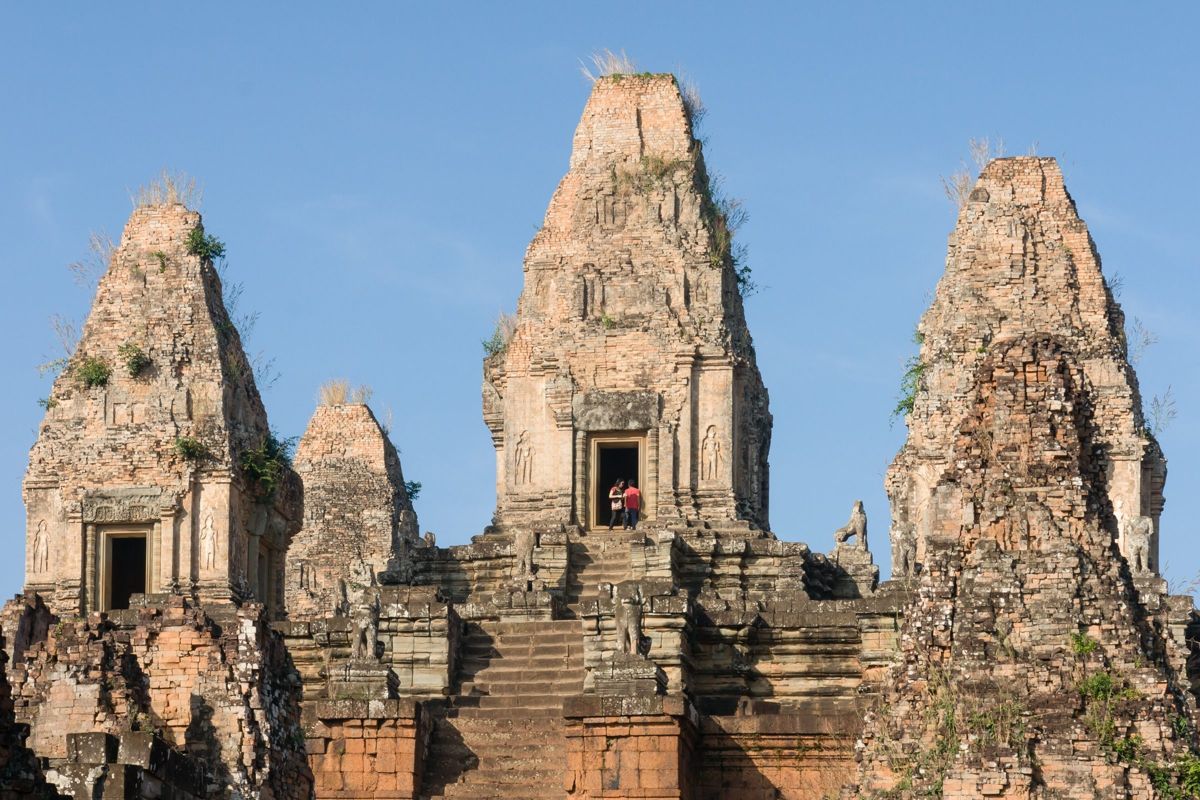
Pre Rup is the sunset temple. Its laterite causeway enters from the east, but its upper terrace looks west over rice fields, which is why it fills in the evening. It opens at 5:00 a.m. and closes at 7:00 p.m. Be on the upper terrace by 6:00 p.m., and expect the guards to clear it at about 6:40 p.m. The choice between the three sunset temples is set out in the Angkor sunset guide. The limitation: the stairs are steep and the descent is in dusk, so a phone light helps.
Phnom Bakheng and Banteay Srei: Two Fixed Appointments
Phnom Bakheng
Phnom Bakheng is ruled by its cap, not by the light. The hilltop temple, just south of Angkor Thom, opens at 6:00 a.m., closes at 7:00 p.m., and limits its summit to 300 people. On peak-season weekends the cap can fill by 4:00 p.m., so arriving by 3:30 p.m. is the only way to be sure of a place. The walk up takes about 20 minutes. Guards start the evacuation about 20 minutes before 7:00 p.m. The limitation: the view toward Angkor Wat is distant, and the waiting is longer than the sunset.
Banteay Srei
Banteay Srei needs the first two hours of the day. It lies 40 to 60 minutes north of town by road, its sanctuary is entered from the east, and its pink sandstone takes the low eastern light best before 9:00 a.m. Sources disagree on the opening hour, with some giving 6:00 a.m. and others 7:30 a.m., so plan to arrive at about 7:30 a.m. Tour coaches arrive from about 9:00 a.m. The inner courtyards have little shade after 9:00 a.m. Leave town at 7:00 a.m. Everything else about the day is in the Banteay Srei guide. The limitation: the drive adds a surcharge to the tuk-tuk, usually $25 to $30 for the day, and the carving is seen from behind a rope.
How Heat and Season Change the Clock
The best hour is not the same in December and April. Three seasons give three different days.
November to February. Highs near 31°C, cool dawns around 20°C, almost no rain. Temples are usable from opening to about 11:30 a.m. and again from about 2:00 p.m. Shaded temples such as Ta Prohm and Preah Khan are bearable at noon. This is also the season of the biggest crowds, with the last ten days of December the busiest of the year, as the December and January guide shows. The open tuk-tuk at 5:00 a.m. is cool enough for a light jacket.
March to May. April’s average high is 35.8°C (96°F), March’s 34.9°C and May’s 34.8°C. Late April brings frequent days at 38°C to 40°C. Between 11:00 a.m. and 3:00 p.m., no open temple is a safe place to stand. The day becomes two short sessions: 5:30 a.m. to 10:00 a.m., and 3:30 p.m. to sunset. Haze from burning rice stubble dulls sunrise from late February. The spring equinox in March fills Angkor Wat’s sunrise: more than 30,000 people came for the March 2026 equinox.
June to October. Sunrise is earliest, about 5:37 a.m. in mid-June, so the morning session starts earlier. Storms usually arrive between 2:00 p.m. and 6:00 p.m., which makes the morning the reliable half of the day. The crowds are at their lowest of the year, and the moats and reservoirs are full. Rain and its effect on plans are in the Siem Reap rainy season guide.
Shoulders and knees must be covered at every temple whatever the hour, and the rule is enforced strictly at the Bakan. A light long-sleeved shirt is cooler than it sounds, as the Angkor dress code guide explains.
A Day Built Around the Best Hours
Here is one way to put the temples in the right light on a single pass day in December. Adjust it 30 minutes earlier from March to May.
- 4:30 a.m. Pickup. Sunrise at Angkor Wat’s south pool, about 6:19 a.m. in mid-December.
- 6:45 a.m. Angkor Wat’s galleries and, from 7:40 a.m., the Bakan, while the sunrise crowd leaves.
- 8:30 a.m. The Bayon from its east side, then the Terrace of the Elephants, out by 10:00 a.m. The Bayon is filling by then, so this is the compromise of the day.
- 10:30 a.m. Ta Keo’s base and Banteay Kdei instead of Ta Prohm.
- 11:30 a.m. to 2:30 p.m. Back to town. Lunch and rest.
- 2:30 p.m. Ta Prohm as the groups leave.
- 4:15 p.m. Pre Rup, on the upper terrace by about 5:15 p.m. for sunset at about 5:40 p.m.
On a three-day pass the same logic gets easier: one morning for Angkor Wat and the Bayon, one for Banteay Srei, one for the grand circuit, and the afternoons free for Ta Prohm, Angkor Wat’s facade and a sunset temple. How many days Angkor needs sets out the pass choice, and the 3-day Siem Reap itinerary lays the days out in full.
By Situation
You have only one day
Do sunrise at Angkor Wat, the galleries at 6:45 a.m., the Bayon by 8:30 a.m., and Ta Prohm after lunch. That gives three of the four main temples in usable light. The day plan above is built for this.
You hate crowds more than early starts
Skip the Angkor Wat sunrise. Start at Ta Prohm or the Bayon at 6:00 a.m., when both are nearly empty. Go to Angkor Wat at 3:30 p.m. for the facade, or watch sunrise from Srah Srang instead. On a spare morning, the Roluos group, 25 minutes east of town, is close to empty at 8:00 a.m. even in December.
You are traveling with children
Sleep in. Arrive at Angkor Wat at about 7:00 a.m., when the sunrise crowd is leaving and the galleries are quiet, and be back at the pool by noon. Ta Prohm at 3:00 p.m. is the afternoon temple children remember. Angkor with kids has the rest. The Bakan is closed to children under 12.
You want photographs
Plan around direction. East-facing temples (Ta Prohm, Banteay Srei, Preah Khan, the Bayon’s east faces) in the first two hours. Angkor Wat’s facade from 3:30 p.m. The Bayon’s north and west faces after 4:00 p.m.
You are visiting in April
Two sessions only: 5:30 a.m. to 10:00 a.m. and 3:30 p.m. to sunset. Shaded temples in the morning’s second half, Ta Prohm at 3:00 p.m. at the earliest, and nothing on an open terrace at midday.
You are in town on December 6, 2026
The Angkor Wat International Half Marathon starts in front of Angkor Wat at 5:45 a.m. that Sunday, with runners arriving from 4:30 a.m. The area in front of the temple is the race start and finish that morning until about 10:30 a.m. Start the day at Ta Prohm or Banteay Srei instead. The half marathon guide has the times.
What It Actually Costs
The best hours cost a little more, mostly in early starts and a second trip.
| Item | Price | Notes |
|---|---|---|
| Angkor Pass, 1 day | $37 | Dated for tomorrow, it admits you from 4:45 p.m. today |
| Angkor Pass, 3 days | $62 | Usable on any 3 days within 7 |
| Angkor Pass, 7 days | $72 | Usable on any 7 days within 30 |
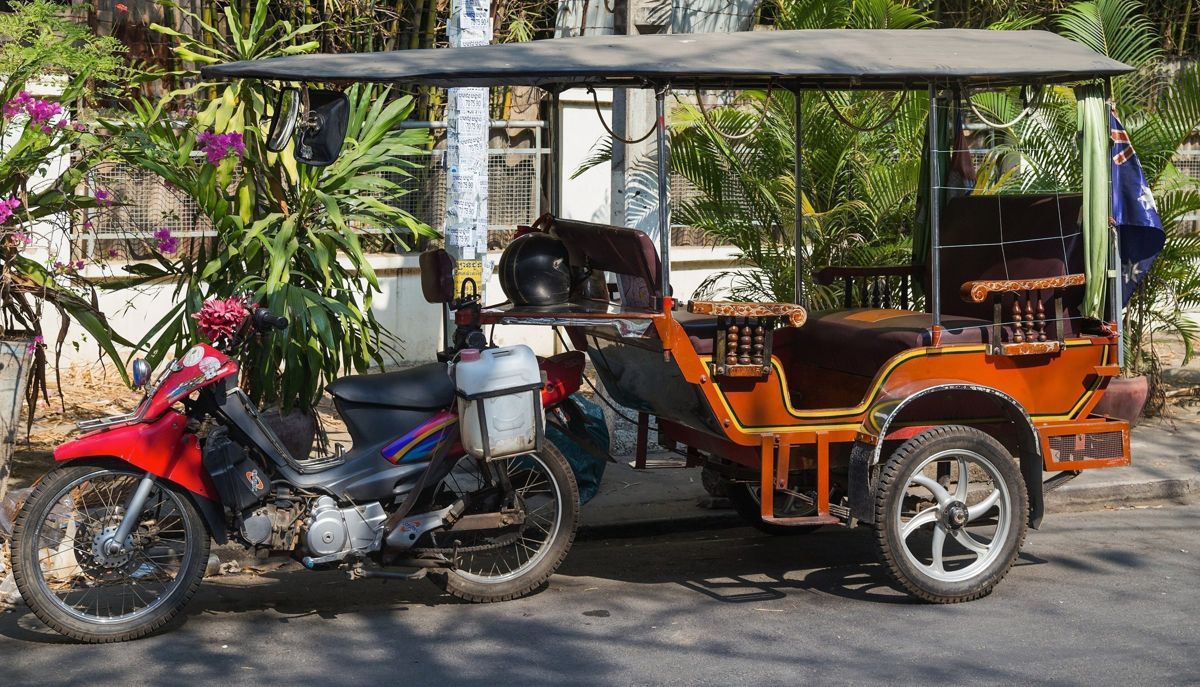
| Tuk-tuk, small circuit day | $18 to $25 | One vehicle for the group |
| Sunrise pickup at 4:30 a.m. | about $5 extra | On top of the day rate |
| Tuk-tuk day with Banteay Srei | $25 to $30 | The 40 to 60 minute drive each way |
| Split day (back to town at midday) | No published rate | Agree on it when hiring the driver |
| Licensed guide, English | $30 to $50 a day | Plus about $15 for a sunrise start at one agency |
The split day is the best value change on the list. Many day hires include a return to town for lunch and a 2:30 p.m. pickup, but it should be agreed when you hire the driver, as the Angkor tuk-tuk, car and bike guide explains. A guide is worth most in the early-morning galleries of Angkor Wat, as hiring a licensed Angkor guide explains. Payment is in dollars, with change under $1 given in riel.
What Other Guides Get Wrong
- “Go early” for every temple. Angkor Wat faces west. Its facade is in its own shadow all morning, and its best light comes after 3:30 p.m.
- “Midday is empty.” Some groups break for lunch, but one tour operator’s own estimates put Angkor Wat at its fullest between 10:00 a.m. and noon. Midday is hot, not reliably quiet.
- “Sunset at Angkor Wat.” The temple closes at 6:00 p.m. From February to September the sun sets after closing, so the sunset belongs to Pre Rup, Srah Srang or Phnom Bakheng.
- Pandemic-era hours. Many pages still print 7:30 a.m. to 5:30 p.m. for every temple. Most now open at 6:00 a.m. and close at 6:30 p.m., and Angkor Wat opens at 5:00 a.m.
- Phnom Bakheng at 5:00 p.m. On peak-season weekends the 300-person cap can be full by 4:00 p.m.
- One timetable for all year. Sunrise moves from about 5:37 a.m. in June to about 6:31 a.m. in January, and the safe midday window shrinks by hours from March to May.
Addresses, hours, prices and transport times checked against operator websites and official sources in November 2026. Hours change seasonally and prices change often. Confirm anything time-critical with the operator.
Where to Go Next
The ticket, the opening hours table and the evening entry rule are in the Angkor Pass guide. For the two ends of the day, the Angkor Wat sunrise guide and the Angkor sunset guide go into the spots in detail. To turn the timings into a route, the small circuit and grand circuit guide puts the temples in order, and the best time to visit Siem Reap sets the season.
Addresses, hours, prices and transport times checked against operator websites and official sources in November 2026. Hours change seasonally and prices change often. Confirm anything time-critical with the operator. Found an error? Tell us and the guide's review date will be updated.
Frequently Asked Questions
What is the best time of day to visit Angkor Wat?
Two windows work. The first is opening, 5:00 a.m., for the sunrise behind the towers, followed by the interior from about 6:45 a.m. when the sunrise crowd leaves for breakfast. The second is from about 3:30 p.m. to the 6:00 p.m. closing, when the west-facing facade takes the afternoon light and the tour groups thin out. Late morning is the hour to avoid: one Siem Reap tour operator estimates the temple holds its largest crowd between 10:00 a.m. and noon. The Bakan, the upper tier, opens at about 7:40 a.m. and closes at about 5:00 p.m., so a climb has to sit inside those hours.
Is it better to visit Angkor temples in the morning or the afternoon?
The morning, for most temples, because most of them face east. The Bayon, Ta Prohm, Preah Khan, Pre Rup, Ta Keo and Banteay Srei were built to be approached from the east, and their carved fronts are lit by the low sun in the first two hours of the day. The exception is Angkor Wat, which faces west and is at its best in the afternoon. The practical plan is a temple morning from 6:00 a.m. to about 10:30 a.m., a long break, and a second session from 2:30 or 3:00 p.m. to sunset, with Angkor Wat or a sunset temple last.
What time do the Angkor temples open and close?
The park admits visitors from 5:00 a.m. and closes at 6:30 p.m. Angkor Wat opens at 5:00 a.m. and closes at 6:00 p.m. Most small and grand circuit temples, including the Bayon, Ta Prohm, Preah Khan, Ta Keo and Banteay Kdei, open from 6:00 a.m. to 6:30 p.m. Srah Srang, Pre Rup and Phnom Bakheng stay open until 7:00 p.m. for sunset. Visitors inside at closing get about 30 minutes to walk out. Banteay Srei's opening hour is disputed between sources, 6:00 a.m. or 7:30 a.m., so plan to arrive at about 7:30 a.m.
When are the Angkor temples least crowded?
At opening, between 6:00 a.m. and 8:00 a.m., at every temple except Angkor Wat's sunrise pools, and in the last hour and a half before closing. The heaviest hours across the park run from about 8:30 a.m. to 11:00 a.m., when tour groups follow the same route from Angkor Wat to the Bayon to Ta Prohm. Midday is not reliably empty. Some groups break for lunch from noon, but the heat makes the empty temples a poor bargain. The quietest single slot of the day is Ta Prohm or the Bayon after 4:00 p.m. in December and January.
Is it too hot to visit Angkor in the middle of the day?
From March to May, yes. April's average high in Siem Reap is 35.8°C (96°F), and days at 38°C to 40°C are frequent late in the month. Between 11:00 a.m. and 3:00 p.m. in those months, no temple with open terraces is a safe place to stand. From November to January the midday heat is lower, with highs near 31°C, and a shaded temple such as Ta Prohm or Preah Khan is bearable at noon. The open terraces of Pre Rup, Ta Keo and the Bayon's upper level are not. In the rainy season, storms usually arrive between 2:00 p.m. and 6:00 p.m.
What time should I leave my hotel for an Angkor temple day?
For sunrise at Angkor Wat, leave at about 4:30 a.m. in November and December, a little later in January, when sunrise is close to 6:30 a.m. The ride from the center takes 15 to 20 minutes plus the stop at the Road 60 ticket office if you have no pass. Without sunrise, leave at about 5:45 a.m. to be at the Bayon or Ta Prohm for the 6:00 a.m. opening. For Banteay Srei, leave by 7:00 a.m., because the drive takes 40 to 60 minutes and the coaches arrive from about 9:00 a.m. Most drivers add about $5 for a 4:30 a.m. start.
Which Angkor temple is best at sunset?
Pre Rup is the classic choice, open until 7:00 p.m., with a view west over rice fields from its upper terrace. Be at the top by 6:00 p.m. Srah Srang is the flat alternative, with no climb. Phnom Bakheng has a view toward Angkor Wat but caps its summit at 300 people, and the cap can fill by 4:00 p.m. on peak-season weekends. Angkor Wat itself closes at 6:00 p.m., so a sunset inside the temple only works from about October to January, when the sun sets before 6:00 p.m. In mid-November 2026, sunset is at about 5:34 p.m.
More Angkor & the Temples guides
Start with the pillar guide: Angkor Pass 2026: Tickets, Prices, Hours and Where to Buy.
-
-
-
-
-
-