On this page
- At a Glance
- The Trap: Treating Roluos as Old Ruins Instead of the First Draft of Angkor
- Preah Ko: Start Here
- Bakong: The First Temple-Mountain
- Lolei: The Temple in a Dry Lake
- Prei Monti and the Rest of Hariharalaya
- How to Do It
- Roluos by Season
- What to Bring
- By Situation
- What It Actually Costs
- What Other Guides Get Wrong
- Where to Go Next
- Frequently Asked Questions
The Roluos group is the best half day at Angkor for anyone who has already seen the big three and wants to know where they came from. Three temples, Preah Ko, Bakong and Lolei, stand 25 minutes east of town at Hariharalaya, the royal capital before Angkor, and were built between 879 and 893. They are covered by the Angkor Pass, they take about two hours, and even in high season they are close to empty at 8:00 a.m.
Most advice online lists Roluos as “the earliest temples” and stops there. It leaves out what makes the visit work: the three temples were built in a sequence that reads as a story, Bakong is the prototype of the temple-mountain that Angkor Wat perfected, and the carving at Preah Ko is better than its worn reputation. It also rarely says when Roluos is the wrong choice. This guide sits under the Angkor Pass guide, which sets the ticket rules for the whole park, and details one of the half days in the day trips from Siem Reap guide.
Prices, hours and transport times below were checked against operator websites and official sources in November 2026.
The Trap: Treating Roluos as Old Ruins Instead of the First Draft of Angkor
Visitors who go to Roluos after Banteay Srei or Angkor Wat often come back underwhelmed. They expected another Ta Prohm, and they found brick towers, eroded stucco and a pyramid without galleries. Seen as a list of three more temples, Roluos loses to almost everything else on the pass.
Seen as a sequence, it does not. Jayavarman II, credited by later inscriptions with founding the Khmer kingdom, is recorded as ending his reign at Hariharalaya. His successor Indravarman I built Preah Ko in 879 to honor his ancestors, Bakong in 881 as his state temple, and dug the Indratataka reservoir. His son Yasovarman I built Lolei in 893 on an island in that reservoir, then moved the capital to a new city around Phnom Bakheng, inside today’s Angkor park. Within three hours, a visitor walks through the three building types that define everything at Angkor afterward: the ancestor shrine, the temple-mountain and the temple on water.
The practical consequence is the order of the visit and the day it falls on. Roluos belongs on the second or third morning, after Angkor Wat and the Bayon. The how many days at Angkor guide puts it on day three or later for that reason, and the order below follows the building dates.
Preah Ko: Start Here
What it is
The honest verdict: the most rewarding of the three for detail, and the right first stop. Preah Ko was dedicated in 879 under Indravarman I, according to its inscribed stele. It is a family shrine. Six brick towers stand in two rows of three on one low sandstone platform, facing east. The front central tower, the tallest, honors Jayavarman II. The tower to its left honors Indravarman’s father and the one to the right his grandfather. The three rear towers were for their wives.
The name means “sacred bull.” It comes from the three sandstone statues of Nandi, Shiva’s mount, that lie in front of the towers. The sandstone lintels above the doorways are the reason to slow down. One shows warriors riding three-headed nagas, horsemen and a deity above a kala head, carved with a density that the later temples rarely matched. Traces of the original stucco still cling to the brick in places.
Practical facts
Preah Ko is about 25 minutes by tuk-tuk from Pub Street, reached by National Road 6 east to Roluos, with signs at the turnoff. Drink and coffee stalls stand opposite the east entrance. A visit takes 30 to 60 minutes. The towers were restored in the early 1990s with funding from the German government. Since early 2024, the APSARA National Authority and the German Apsara Conservation Project have been working on the deteriorated southern tower, so expect scaffolding on part of the platform.
The limitation: the site is small and flat, and visitors who are not interested in carved lintels see it in ten minutes. That is the case for starting here, while attention is fresh.
Bakong: The First Temple-Mountain
What it is
The honest verdict: the main reason to make the trip, and the clearest lesson in how Angkor Wat came to look the way it does. Bakong was completed in 881 as the state temple of Indravarman I. It is a pyramid of five sandstone levels, 65 by 67 m at the base, rising to a summit sanctuary. It represents Mount Meru, the home of the gods, as every temple-mountain after it does, and it was the first built at this scale in sandstone.
The site is larger than it looks from the road. It measures about 900 by 700 m, with three enclosures separated by two moats. Between the moats lie the remains of 22 smaller brick shrines. The inner enclosure holds the pyramid and eight brick towers around its base. The central tower at the summit is not original. It dates from the 12th century, the era of Angkor Wat, and its shape is the reason Bakong looks more familiar than its date suggests. The French conservator Maurice Glaize rebuilt the pyramid in the 1930s by anastylosis, taking it apart and reassembling it stone by stone.
Practical facts
Allow about an hour, including the climb. The steps on each face are steep but short, with no handrail, and the top level gives a view over the treetops of the enclosure. A working Buddhist monastery stands just outside the eastern gate, and monks are often in the grounds. Dress with shoulders and knees covered, as explained in the Angkor dress code guide. The APSARA National Authority and the German Apsara Conservation Project run a long-term program to conserve the stucco on the brick towers, and in 2022 their work on the eighth tower was reported.
The limitation: the pyramid has no galleries, no roof and no shade. After 10:00 a.m. from March to May, the climb is a poor idea. Visitors who want carving should look at the lower towers and lintels, not at the summit.
Bakong at sunset
Bakong closes at 6:30 p.m., and from October to February the sun sets well before that, at about 5:34 p.m. in mid-November and 5:40 p.m. in mid-December. A late-afternoon Roluos visit can end on the pyramid. The view is of trees and the monastery roof rather than a horizon. The Angkor sunset spots guide compares it with Pre Rup, Phnom Bakheng and Phnom Krom.
Lolei: The Temple in a Dry Lake
What it is
The honest verdict: a short, worthwhile third stop for the story, not for the stones. Lolei was completed in 893 under Yasovarman I, Indravarman’s son. Its four brick towers honor the king’s grandparents and parents. It was built on an island near the center of the Indratataka, the reservoir that Indravarman I had dug for his capital. The reservoir is now dry farmland, so the island is a low mound in the fields, and imagination has to supply the water.
Lolei repeats the idea of Preah Ko on a smaller scale, and it anticipates the West Mebon and East Mebon, the island temples later built in Angkor’s larger reservoirs. A Buddhist monastery stands beside it.
Practical facts
Allow 15 to 20 minutes. Lolei is a few minutes by tuk-tuk from the other two. The APSARA National Authority has been restoring it for several years: the southeast tower from 2021, the southwest tower from March 2022, and the lower structures around the southwest and northwest towers in 2024. Parts of the platform may be fenced or under scaffolding on the day.
The limitation: of the three, Lolei is the one to drop if time or energy runs short. It has the weakest surviving decoration, and the restoration work hides some of it.
Prei Monti and the Rest of Hariharalaya
Prei Monti is the fourth, smaller temple of the group, and most visitors skip it. It is on the Angkor Pass, but it keeps the older 7:30 a.m. to 5:30 p.m. hours, so it does not fit an early start. It is worth adding only with a guide who knows the site. The rest of Hariharalaya is invisible without one: the ancient capital was built mostly of wood, and what survives is earthworks, ponds and the line of the dry reservoir.
How to Do It
The morning plan
Leave Pub Street at 7:00 or 7:30 a.m. Start at Preah Ko for 45 minutes, move to Bakong for an hour, end at Lolei, and be back in town by 10:30 a.m. This avoids the heat on Bakong’s stairs and leaves the afternoon free. The best time of day at Angkor guide explains why the outlying temples suit the first hours of the day better than the late ones.
The sunset plan
Leave at 3:30 p.m. from November to February. Visit Lolei and Preah Ko first and climb Bakong for the last light. This works best when combined with nothing else.
With the floating villages
Kampong Phluk, the stilt village on the Tonle Sap, lies in the same district, Prasat Bakong, about an hour from Pub Street. Roluos at 8:00 a.m., lunch in town, then Kampong Phluk at 3:00 p.m. is a full and coherent day. The Tonle Sap floating villages guide explains which village to choose by month. From about August to January, Kampong Phluk has enough water for the boat.
Transport
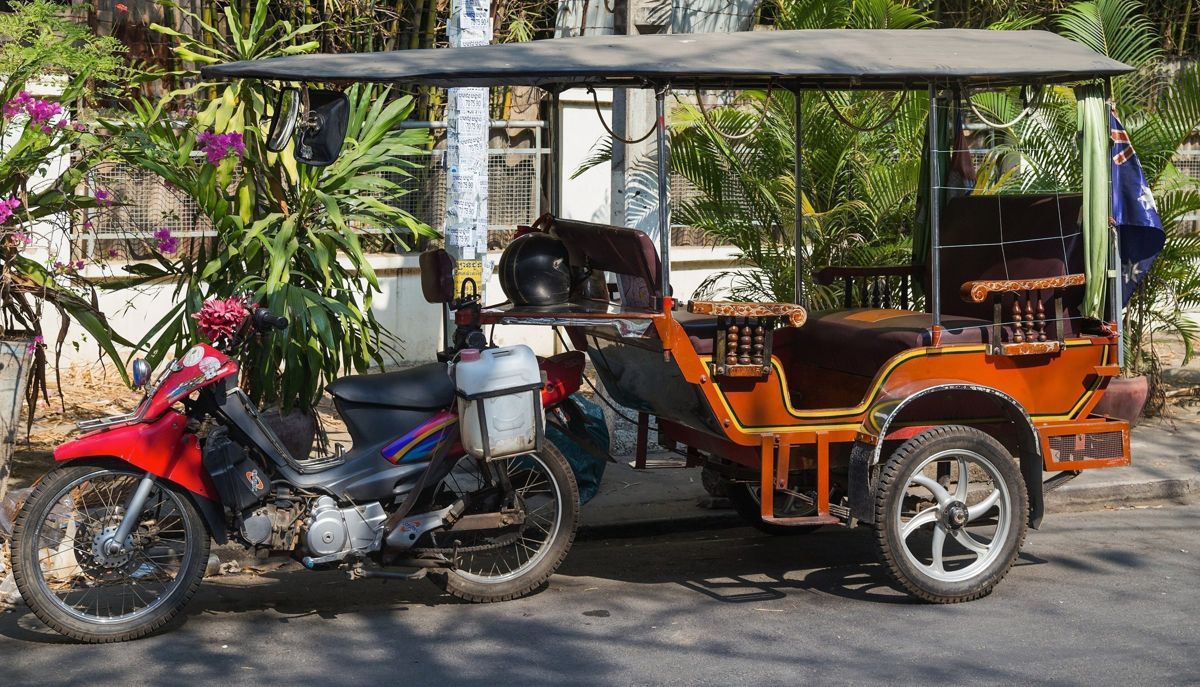
A tuk-tuk is the natural choice: the road is flat, the distance short, and the ride about 25 minutes. Expect about $15 to $20 for the half day with waiting time, agreed before leaving. The tuk-tuk, car or bike guide covers the alternatives. Cycling is possible on the cool mornings of December and January, but National Road 6 carries heavy traffic and offers no shade.
A guide or not
Roluos is where a licensed guide changes the visit most, because the meaning lies in the dates, the dedications and the inscriptions rather than in the size of the buildings. Licensed English-speaking guides charge about $30 to $50 a day in 2026. The hiring an Angkor guide guide explains how to find one. Without a guide, read the three short sections above before going.
Roluos by Season
November to February
The best months. Mornings are cool enough to climb Bakong at 9:00 a.m. without distress, the fields around Lolei are green after the rains, and the sun sets early enough for a Bakong sunset before closing time. Crowds at Angkor peak in December and January, but they concentrate at Angkor Wat at sunrise and at Ta Prohm before 10:00 a.m. Roluos stays quiet, which is the strongest argument for a December visit. The December and January guide covers the rest of the peak season.
March to May
The hot months. Start at 7:00 a.m. and be finished by 10:00 a.m., because none of the three temples offers shade and Bakong’s stone holds the heat. Between 11:00 a.m. and 3:00 p.m., do not visit at all. The fields are dry and brown, and the outline of the old reservoir is easier to read. Carry water from town.
June to October
The green season. Rain usually falls in the afternoon, so the morning plan still works. Paths around Bakong’s moats and Lolei’s mound turn muddy, and the steep steps of the pyramid are slippery after rain. The reward is the color: rice fields full of water around Lolei give a faint idea of the reservoir that once surrounded it. The rainy season guide explains how to plan around the showers.
What to Bring
Water, a hat and sunscreen in every season, because the three temples are open to the sky. Clothes that cover shoulders and knees. Shoes with grip for Bakong’s steps. Small US dollar notes for drinks and the tuk-tuk. A printed or saved copy of the Angkor Pass if it was bought online, since staff check it at the temples. A short reading on the three kings, Jayavarman II, Indravarman I and Yasovarman I, turns the visit from three ruins into one story.
By Situation
You have a three-day pass and one free morning
Use it here. Preah Ko, Bakong and Lolei fill a morning, cost nothing extra and give a quiet counterpoint to the crowds at Angkor Wat. The three-day itinerary shows where a free morning usually falls.
You have one day at Angkor
Skip Roluos. Angkor Wat, the Bayon and Ta Prohm come first, and the extra hour on the road costs one of them. The small and grand circuit guide is the better plan.
You are interested in Khmer history
Go with a guide, ask about Prei Monti, and see the three temples in date order. Then visit Preah Khan, Neak Pean and Ta Som, 300 years later, to see where the style ended.
You are traveling with children
Bakong is a good climb for children over about six, steep but short. Preah Ko’s Nandi bulls are an easy hook. Keep it to a morning and pair it with the boat at Kampong Phluk in the afternoon.
You want a quiet sunset
Finish at Bakong from November to February. Few people come, and the monastery next door is part of the scene.
What It Actually Costs
| Item | Price | Notes |
|---|---|---|
| Angkor Pass, one day | $37 | Children under 12 free with passport |
| Angkor Pass, three days | $62 | Valid on any 3 days within 7 |
| Angkor Pass, seven days | $72 | Valid on any 7 days within 30 |
| Tuk-tuk, Roluos half day with waiting | $15 to $20 | Agree the price before leaving |
| Tuk-tuk, Roluos plus Kampong Phluk day | About $34 | Published rate of one Siem Reap agency |
| Kampong Phluk boat and community fee | $20 plus $2 per person | Paid at the community office |
| Licensed guide, English, full day | $30 to $50 | More for other languages |
The pass covers all four Roluos temples. Nothing else is charged on site. Pay in US dollars, with small notes, because riel change is normal under $1 and torn bills are refused.
What Other Guides Get Wrong
- “Roluos needs a separate ticket.” It does not. The Angkor Pass covers Preah Ko, Bakong, Lolei and Prei Monti. Separate tickets apply to Beng Mealea, Koh Ker and Phnom Kulen, not to Roluos.
- “The temples open at 7:30 a.m.” That was the pandemic-era schedule. Angkor Enterprise lists the Roluos group as open from 6:00 a.m. to 6:30 p.m. Only Prei Monti still keeps 7:30 a.m. to 5:30 p.m.
- “Lolei stands in a lake.” It did, in the 9th century. The Indratataka has been dry for centuries, and the island is now a mound in the fields.
- “Bakong looks exactly as it did in 881.” The summit tower dates from the 12th century, and the pyramid was rebuilt stone by stone in the 1930s.
- “Roluos is a good first-day temple because it is old.” Age is the reason to go later, not first. The temples make sense after seeing what they led to.
- “Roluos takes a full day.” The three main temples take about two hours on site. A full day only makes sense when combined with the floating villages.
Addresses, hours, prices and transport times checked against operator websites and official sources in November 2026. Hours change seasonally and prices change often. Confirm anything time-critical with the operator.
Where to Go Next
The Angkor Pass guide sets the ticket rules and opening hours for every temple in the park. For the other half days outside the main circuits, the day trips from Siem Reap guide compares Roluos with Phnom Krom, Banteay Samre and the lake villages. Banteay Srei shows the finest carving of the 10th century, a useful comparison with Preah Ko’s lintels. For the full story of the empire that started here, read Angkor’s history explained.
Addresses, hours, prices and transport times checked against operator websites and official sources in November 2026. Hours change seasonally and prices change often. Confirm anything time-critical with the operator. Found an error? Tell us and the guide's review date will be updated.
Frequently Asked Questions
Is the Roluos group worth visiting?
Yes, on a second or third day at Angkor, and for anyone curious about how the empire began. Preah Ko, Bakong and Lolei were built between 879 and 893 at Hariharalaya, the capital before Angkor. Bakong is the first large sandstone temple-mountain, the model that Angkor Wat later refined. The three temples are 25 minutes from town, covered by the Angkor Pass and quiet even in December. On a single day that has not yet covered Angkor Wat, the Bayon and Ta Prohm, Roluos comes after them. Its carving is earlier and more worn, and its brick towers look plain to tired eyes.
Is the Roluos group included in the Angkor Pass?
Yes. Preah Ko, Bakong, Lolei and Prei Monti are all covered by the Angkor Pass, which costs $37 for one day, $62 for three days valid over seven days and $72 for seven days valid over 30 days. Children under 12 enter free with a passport. Staff check the pass at the temples, so a Roluos morning has to fall on a pass day. It is the cheapest way to use a spare morning of a three-day pass. No separate ticket exists for Roluos, unlike Beng Mealea, Koh Ker or Phnom Kulen.
How long do you need at Roluos?
About two hours on site, three to three and a half hours from hotel door to hotel door. Preah Ko takes 30 to 60 minutes, Bakong about an hour with the climb to the top, and Lolei 15 to 20 minutes, partly because restoration has kept parts of it behind scaffolding in recent years. The drive from Pub Street is about 25 minutes each way. A 7:30 a.m. start puts you back in town by about 10:30 a.m., which leaves the hottest hours for lunch and a pool.
How far is Roluos from Siem Reap?
About 13 to 15 km east of the town center, along National Road 6 toward Phnom Penh. By tuk-tuk from Pub Street, the ride takes about 25 minutes, depending on traffic on Road 6 out of town. A tuk-tuk for the half day with waiting time costs about $15 to $20. By bicycle on flat roads it is roughly an hour each way, which only makes sense in the cool months and starting early, because most of the road is busy and unshaded.
What order should you visit the Roluos temples in?
Preah Ko first, then Bakong, then Lolei, which is the order in which they were built: 879, 881 and 893. Preah Ko has the drink stalls opposite its east entrance and is a gentle start. Bakong is the main event and deserves the hour before the sun climbs high. Lolei is the short last stop. If sunset is the aim instead, reverse the order in the late afternoon and finish at Bakong, which closes at 6:30 p.m. In November and December the sun sets there at about 5:35 to 5:40 p.m.
Can you combine Roluos with the floating villages?
Yes, and it is the most common pairing. Kampong Phluk, the stilt village on the Tonle Sap, lies in the same district, Prasat Bakong, about an hour from Pub Street. A practical plan is Roluos at 8:00 a.m., back to town for lunch, then Kampong Phluk at 3:00 p.m. for the boat and the sunset. One Siem Reap agency prices the full tuk-tuk day for Roluos plus Kampong Phluk at $34. The Kampong Phluk boat is extra: $20 per person plus a $2 community fee at the community office.
What should you wear at Bakong and Lolei?
Shoulders and knees covered, for men and women, as at every temple in the Angkor park. APSARA's code of conduct bans bare shoulders and shorts or skirts above the knee at sacred sites. At Roluos it matters twice over, because working Buddhist monasteries stand beside Bakong and Lolei, and monks live in them. Light trousers or a long skirt and a T-shirt are enough. Bakong's pyramid has steep stone steps, so shoes with a grip matter more than sandals.
More Angkor & the Temples guides
Start with the pillar guide: Angkor Pass 2026: Tickets, Prices, Hours and Where to Buy.
-
-
-
-
-
-