On this page
The Siem Reap riverside is the best free hour in town, and it works only at the two ends of the day. Pokambor Avenue follows the west bank of the Siem Reap River for about 1.2 km from the Old Market to the Royal Independence Gardens. The walk is flat and shaded in places, and it passes a pagoda, a shrine that matters more to Cambodians than any temple in the park, and a colony of fruit bats. At noon in April it is a walk along a hot road.
Most descriptions of the riverside treat it as a backdrop for dinner. They skip the order of the walk, the time of day that makes it work, the dress rule at the pagoda and what happens to the banks during the Water Festival, which in 2026 falls in the same week as this guide. This guide gives the route end to end, from the gardens down to Wat Preah Prom Rath and the Old Market, and a return along the east bank. The Siem Reap neighborhoods guide sets the riverside against the rest of town.
Prices, hours and transport times below were checked against operator websites and official sources in November 2026.
The River Is a Route, Not a View
The trap is expecting a river view. The Siem Reap River is narrow in town, brown in the rainy season, and low and sometimes smelly in the dry months. Nobody walks it for the water.
What the walk gives is a sequence. In 15 minutes on foot the west bank goes from the market’s noise to a pagoda courtyard, then to a shrine where families light incense, then to a fan of lawns in front of a 1932 hotel. The east bank, across any of the bridges, is residential, with the Wat Bo pagoda a few minutes inland. Walked in the right order at the right hour, those pieces explain how the town lives better than a museum label does.
The order that works best in the late afternoon is north to south. Start at the gardens around 4:30 p.m., pass the shrine while the evening worship is starting, reach Wat Preah Prom Rath around 5:00 p.m., and arrive at the Old Market at dusk, when the night markets open and the restaurants fill. In the morning, reverse it. Start with breakfast near the Old Market at 7:00 a.m. and end in the gardens before the heat.
Getting to the Start
The Royal Independence Gardens sit at the north end of Pokambor Avenue, where the river meets Charles de Gaulle Boulevard and National Route 6, about 1.2 km from the Old Market. A tuk-tuk from Pub Street costs $2 to $3 and takes about 5 minutes. Ask for “Raffles” or “the Royal Gardens”. Every driver knows both. The getting around guide covers fares and the ride-hailing apps.
Walking up from the Old Market takes about 15 minutes along the west-bank path. It is the same route in reverse, so the choice is only about which end to finish at.
The Royal Gardens End
Royal Independence Gardens
The verdict: the lawns are ordinary, the trees and the people under them are the reason to come. The gardens are a long, open park in front of Raffles Grand Hotel d’Angkor, open 24 hours and free. They have little shade on the lawns themselves and a row of large old trees along the paths. In the late afternoon they fill with Cambodian families, couples on motorbikes and children with balloons. On weekends and public holidays there are more. The Royal Residence stands behind walls next to the gardens and is not a visitor site.
The bats are the detail most visitors miss. The tall trees have long held a colony of large fruit bats, also called flying foxes, and Google reviews from June and July 2026 still describe them hanging in the canopy near the shrine. By day they look like dark folded leaves. Toward dusk they stir, squabble and start to fly. Nobody publishes a count, and numbers vary from one season to another. Look up, stay quiet and leave them alone.
The limitation: the gardens are unlit and almost deserted after 10:00 p.m. Walk back along the road at night, not across the lawns.
Preah Ang Chek Preah Ang Chorm Shrine
The verdict: the most visited place of worship in Siem Reap for Cambodians, and the place on this walk to slow down. The small open shrine stands at the edge of the gardens, by the Royal Residence. Inside are two bronze statues known as Preah Ang Chek and Preah Ang Chorm. Their origin is unknown. They were rediscovered in 1950 in the forest around Angkor Thom. Dap Chhuon, governor of Siem Reap in the 1950s, took them to his own headquarters. They were moved to Wat Damnak in 1973, during the civil war, and accounts of what happened to them under the Khmer Rouge disagree. The present shrine was built from 1982, and the cult was revived with the support of monks and the province.
What you see in the late afternoon is the point of the visit. Families arrive with incense sticks and lotus buds, kneel, pray for luck and leave offerings. Newlyweds come to ask for a good marriage. Vendors sell small caged birds, which people buy and release for merit. During Pchum Ben, Khmer New Year and the Water Festival the queue reaches the road.
Facts for the visit: no ticket, no published hours, open from early morning into the evening. Cover shoulders and knees. Take shoes off if you step onto the raised area. Photograph from the side, never across someone praying. The limitation: the space is small and busy, and a group of visitors standing in the middle of it is in the way. Five minutes at the edge is enough.
Raffles Grand Hotel d’Angkor and the Elephant Bar
The verdict: the building is worth a look from the gardens, and a drink inside is worth it only at happy hour. Raffles Grand Hotel d’Angkor, at 1 Vithei Charles de Gaulle, faces the gardens across the road. It opened in 1932, reopened under the Raffles name on December 30, 1997, and has 119 rooms. The Elephant Bar runs a happy hour from 4:00 to 6:00 p.m., with a pianist from Tuesday to Sunday at 9:30 p.m., and a smart-casual dress code. The limitation: cocktails cost two to three times the Pub Street price, and shorts and flip-flops after a temple day do not fit the dress code. The things to do at night guide compares the bars nearby.
Down Pokambor Avenue
From the gardens, the path follows the west bank south under trees, with the river on the left and the road, shophouses and a few hotels on the right. The ground is paved and flat. Motorbikes use the road beside it, and in places the path narrows, so walk in single file when it does.
Wat Preah Prom Rath
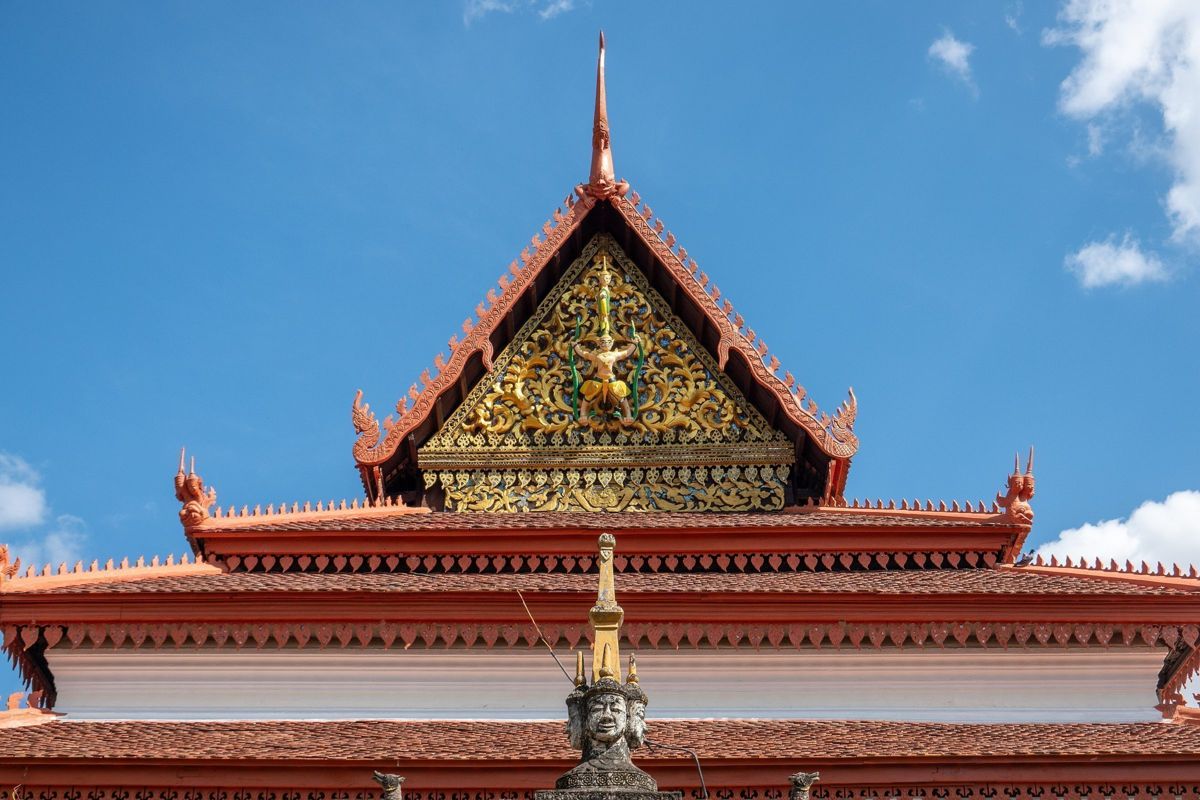
The verdict: the most rewarding pagoda in the center, and the reason to walk this stretch rather than ride it. Wat Preah Prom Rath sits on Pokambor Avenue about halfway between the gardens and the Old Market. It is a working monastery, and its history is usually dated to the turn of the 16th century, though most of the present buildings date from the 1940s and 1950s. The prayer hall is lined with painted walls that tell the life of the Buddha, with a large seated Buddha and a reclining Buddha. APSARA has restored two of the wooden buildings in the compound.
The pagoda’s best-known story is about a monk named Preah Ang Chong Han Hoy. In the legend, his boat was wrecked on the Tonle Sap, and the half that remained carried him home safely. A model of the boat stands in the courtyard, and the reclining Buddha is linked to the same story. Accounts differ on the details, as they do for most pagoda legends. The courtyard also holds sima stones, guardian lions and a pair of old cannons.
Facts for the visit: no ticket office and no published hours. The hall is usually open in the daytime, and chanting is most likely early in the morning and in the late afternoon. Cover shoulders and knees, take shoes off before entering the hall, and do not touch a monk if you are a woman. A dollar or two in the donation box is the usual gesture. The dress code guide covers the same rules for the temples. The limitation: monks live here, novices study here, and the hall is sometimes closed for a ceremony. If it is, the courtyard and the boat are still worth the stop.
FCC Angkor and the Riverside Restaurants
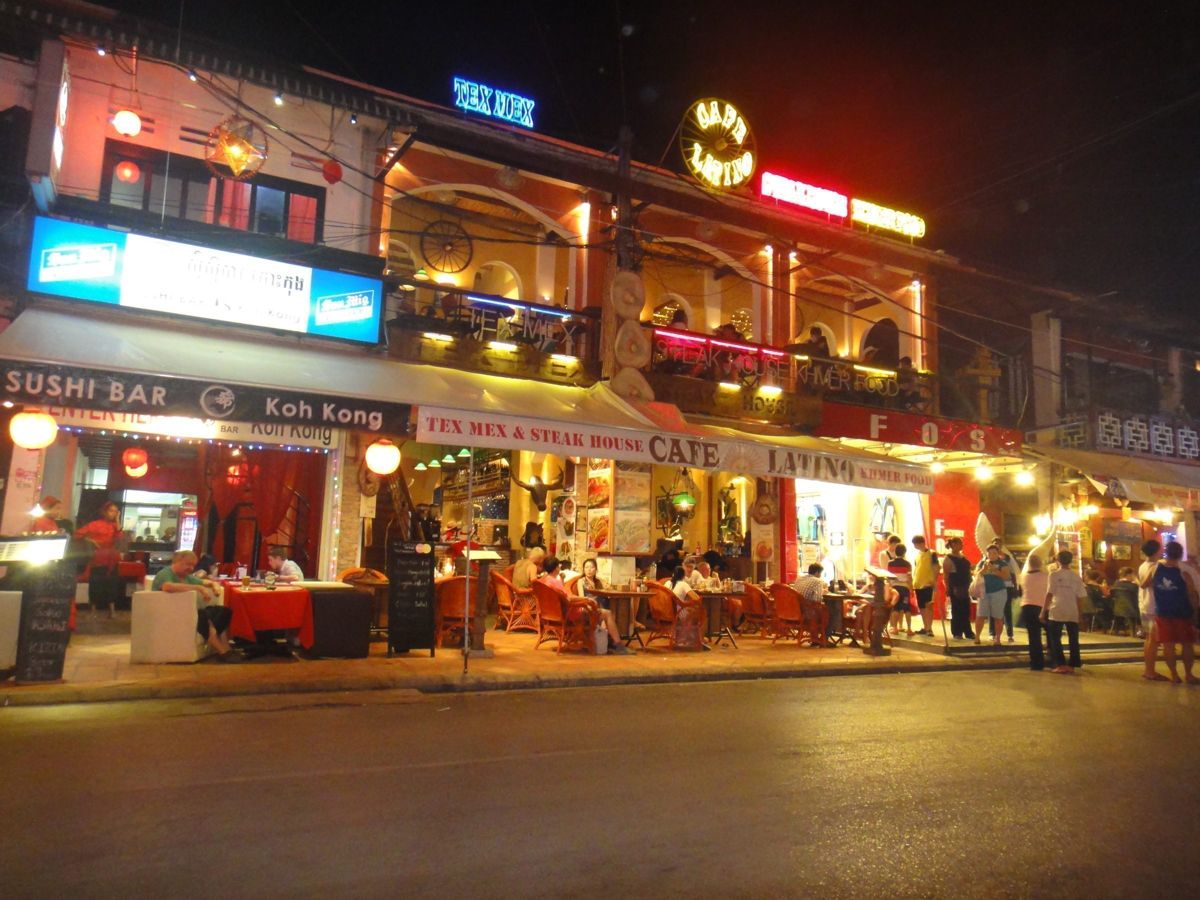
The verdict: this stretch is for eating, and the restaurants are better than the strip around Pub Street. Below the pagoda, Pokambor Avenue becomes the classic Khmer dining strip. FCC Angkor by Avani, in a former colonial residence on the riverside, has a saltwater pool in a courtyard under old trees, and its Scribe Bar opens from 11:00 a.m. to 11:00 p.m. Malis Siem Reap, the riverside branch of chef Luu Meng’s restaurant, opens daily from 11:00 a.m. to 10:30 p.m., with mains from $11 to $38, taxes and service included. Chanrey Tree, a 5- to 10-minute walk north of the Old Market, opens daily for lunch from 11:00 a.m. to 2:30 p.m. and dinner from 5:30 to 10:30 p.m. Its menu lists fish amok at $10.50 and beef lok lak at $11.50, plus 5 percent service and 10 percent tax.
The limitation: these are polished restaurants for visitors, and the prices show it. A street-food plate a few streets inland costs $1 to $2. The best Khmer restaurants guide ranks them, and the food guide covers the dishes.
Sister Srey Cafe and the Old Market End
The verdict: the breakfast stop for the morning version of the walk. Sister Srey Cafe, at 200 Pokambor Avenue in the Angkor Trade Center block near the Old Market, has been run since 2012 by the Gravett sisters and opens daily from 7:00 a.m. to 6:00 p.m. Prices are not posted online. From here, the Old Market, Psar Chas, is two minutes away, with its food section for a plate of bai sach chrouk, grilled pork on rice. The limitation: it is a café for visitors, and a stall breakfast in the market costs a fraction of the price.
The south end of Pokambor Avenue is where the walk meets the town. The Pub Street and Old Market guide covers the streets beyond.
Back Along the East Bank
Cross at the footbridge or the Old Market bridge to return along the east bank. This side has no promenade, only the riverside road, Achasva Street, with the ends of the Wat Bo cross-streets running off it. It is quieter and more residential.
Siem Reap Art Center Night Market
The verdict: the easiest night market to reach on foot, at the end of the walk. The Art Center Night Market sits on the east bank at the foot of the footbridge, opposite the Old Market. It opens Monday to Saturday from 4:00 to 11:00 p.m. and closes on Sundays. The stalls sell scarves, carvings, paintings and the same souvenirs found across town. The limitation: much of the stock is imported, and prices start high for bargaining. The markets guide says what is made in Cambodia.
Wat Bo
The verdict: the second pagoda of the walk, and the one with the older paintings. Wat Bo is a working monastery on Wat Bo Road, a few minutes inland from the river. Its prayer hall carries murals of the Reamker, the Cambodian Ramayana, which guides date to the late 19th century. Entry is free, with donations welcome, and the same dress rules apply. The limitation: Wat Bo Road is a through road with steady motorbike traffic. The Wat Bo guide covers the neighborhood around it.
South to Wat Damnak
For a longer walk, follow the east bank south past 7 Makara Street to Wat Damnak, the pagoda that served as King Sisowath’s royal residence from 1904 to 1927. Its grounds house the Center for Khmer Studies, whose library is open to the public. Cuisine Wat Damnak, in a wooden house nearby, serves a $45 tasting menu from 6:30 p.m., Monday to Saturday. The limitation: the village lanes are dark at night, so this extension is a daytime walk or a tuk-tuk ride.
The Riverside in Festival Week
The 2026 Water Festival, Bon Om Touk, runs on the Siem Reap River from November 20 to 25, with boat races on November 23 and 24 and events at the Royal Residence Park. During those days the riverside is not a quiet walk. The banks between the Royal Gardens and the Old Market are the stands, and tens of thousands of Cambodian visitors fill them. In 2025, the festival drew 368,246 visitors, of whom 9,646 were foreigners, according to the state news agency AKP.
In 2024 the opening ceremony was held at a riverside pavilion on Pokambor Avenue, the races ran from 8:30 to about 10:00 a.m. and from 3:00 to about 5:30 p.m. on the second day, and the fireworks were launched from the west side of the Tep Vong Street bridge at about 6:30 p.m. The 2026 times had not been published when this guide was checked. The Water Festival guide has what is known for this year. Outside festival week, the shrine is busiest during Pchum Ben and Khmer New Year.
The Riverside by Season
From November to February, the walk works at any hour before 11:00 a.m. and after 3:30 p.m. December nights average a low of 20.7°C, and the mornings are the coolest of the year. This is also high season, so the restaurants on Pokambor Avenue need a booking for dinner. The December and January guide covers the crowds.
From March to May, walk only before 9:00 a.m. or after 4:30 p.m. The river is at its lowest and can smell, and the path has little shade at midday.
From June to October, the river rises and the trees are at their thickest. Showers usually come in the afternoon, and after a heavy storm the bank can flood in places. Start early and carry an umbrella. The weather by month guide gives the figures.
By Situation
You have one free hour before dinner
Take a tuk-tuk to the Royal Gardens at 4:30 p.m., see the shrine and the bats, and walk down Pokambor Avenue past Wat Preah Prom Rath to a table at Chanrey Tree or Malis. Book the table in high season.
You want a cool morning walk
Breakfast at Sister Srey Cafe at 7:00 a.m., then walk north past Wat Preah Prom Rath, while the monks are chanting, to the gardens. Take a tuk-tuk to the Angkor National Museum, which opens at 8:30 a.m., a few minutes from the gardens.
You are traveling with children
The gardens are the open space the center otherwise lacks, and the bats keep children looking up. Keep small children on the land side of the path, away from the water’s edge. The Siem Reap with kids guide has more ideas.
You are in town during the Water Festival
Go to the banks for the races and the fireworks, accept the crowds, and use your feet rather than a tuk-tuk, since the riverside roads near the Royal Gardens and the Old Market are closed or slowed in the evenings. Keep the phone in a front pocket.
You want the full loop
Gardens, shrine, Wat Preah Prom Rath and the Old Market on the west bank, then over the footbridge to the Art Center Night Market and inland to Wat Bo. Allow two hours with stops.
What It Actually Costs
The walk itself costs nothing. No part of it needs an Angkor Pass.
| Item | Price | Notes |
|---|---|---|
| Royal Independence Gardens | Free | Open 24 hours |
| Preah Ang Chek Preah Ang Chorm shrine | Free | Incense and lotus sold by vendors |
| Wat Preah Prom Rath and Wat Bo | Free | A $1 or $2 donation is the usual gesture |
| Tuk-tuk to the gardens from Pub Street | $2 to $3 | About 5 minutes |
| Breakfast at Sister Srey Cafe | On request | Prices not posted online |
| Fish amok at Chanrey Tree | $10.50 | Plus 5% service and 10% tax |
| Main course at Malis Siem Reap | $11 to $38 | Taxes and service included |
| Elephant Bar happy hour | On request | 4:00 to 6:00 p.m. |
Pay in dollars. Change under $1 comes back in riel, at about 4,000 riel to the dollar. Torn dollar notes are refused. The money guide explains the two currencies.
What Other Guides Get Wrong
- “Stroll along the river at lunchtime.” The path has little shade at midday, and from March to May it is hot enough to be unpleasant. Walk before 9:00 a.m. or after 4:30 p.m.
- “The Royal Gardens are a royal palace you can visit.” The Royal Residence is behind walls and closed to visitors. The public part is the gardens and the shrine.
- “The shrine is a photo stop.” It is an active place of worship. Watch from the edge and do not photograph people praying at close range. The temple etiquette guide covers shoes, monks and photographs in the town pagodas.
- “The bats are gone.” Reviews from mid-2026 still describe fruit bats in the trees by the shrine. Their numbers vary, but they have not been reported gone.
- “Walk back through the gardens after dinner.” The gardens are unlit and almost empty after 10:00 p.m. Walk along the road, or take a $2 to $3 tuk-tuk.
- “The riverside is the same in every season.” It is a quiet promenade most weeks and a festival ground during the Water Festival, which in 2026 runs from November 20 to 25.
Addresses, hours, prices and transport times checked against operator websites and official sources in November 2026. Hours change seasonally and prices change often. Confirm anything time-critical with the operator.
Where to Go Next
The Siem Reap neighborhoods guide explains where the riverside fits in the town, and the Wat Bo guide covers the east bank in detail. For an evening built around the walk, the things to do at night guide lists the bars and shows nearby, and the street food guide says where to eat cheaply once you reach the Old Market. The Angkor National Museum guide is the natural next stop from the gardens, and the free things to do in Siem Reap guide lists the other places in town that cost nothing.
Addresses, hours, prices and transport times checked against operator websites and official sources in November 2026. Hours change seasonally and prices change often. Confirm anything time-critical with the operator. Found an error? Tell us and the guide's review date will be updated.
Frequently Asked Questions
How long is the riverside walk in Siem Reap?
The west-bank stretch from the Old Market bridges to the Royal Independence Gardens is about 1.2 km, roughly 15 minutes on foot without stops. With the shrine, Wat Preah Prom Rath and a coffee, plan on 60 to 90 minutes. Crossing at the gardens and coming back down the east bank to the Art Center Night Market and Wat Bo turns it into a loop of roughly 2.5 km, which most people walk in under two hours with stops. The ground is flat, and the path is paved for most of its length.
What is the best time to walk along the Siem Reap River?
Between 7:00 and 9:00 a.m., or from about 4:30 p.m. to sunset, which falls around 5:34 p.m. in mid-November and 5:40 p.m. in mid-December. The morning is coolest and the pagoda is quiet. The late afternoon is when Cambodian families come to the shrine with incense and lotus buds, the bats stir in the trees, and the walk ends at the Old Market as the night markets open. From March to May, avoid 11:00 a.m. to 3:00 p.m. entirely. The path has little shade at midday.
Can you see the bats in the Royal Gardens in Siem Reap?
Usually, yes. The tall trees in the Royal Independence Gardens have long held a colony of large fruit bats, also called flying foxes, and Google reviews from June and July 2026 still describe them hanging in the trees by the shrine. They are visible by day as dark shapes in the canopy and become active around dusk. Numbers vary, and nobody publishes a count. Look up from the path near the shrine, keep your voice down, and do not throw anything to make them fly.
Is the Siem Reap riverside safe at night?
The lit stretch between the Old Market and the footbridges is busy until late and is part of the normal walk home from Pub Street. North of the market, the gardens are unlit and almost empty after 10:00 p.m., so walk back along the road rather than through them. The routine risk is bag and phone snatching from passing motorbikes on the riverside roads. Carry the bag on the side away from traffic and keep the phone in a pocket while walking. A tuk-tuk home costs $2 to $3.
What is the shrine of Preah Ang Chek Preah Ang Chorm?
It is the small shrine by the Royal Independence Gardens, near the Royal Residence, where two bronze statues known as Preah Ang Chek and Preah Ang Chorm are worshipped. They were rediscovered in 1950 in the forest around Angkor Thom, held by the 1950s governor Dap Chhuon, and moved during the civil war. Accounts of what happened to them under the Khmer Rouge differ. The shrine was built from 1982. Cambodians come to pray for luck, especially newlyweds, and it fills up during festivals. Visitors may watch quietly, with shoulders and knees covered.
Is the Siem Reap riverside worth it during the Water Festival?
Worth it if you like crowds and want to see the one big festival most visitors miss. In 2026 the festival runs from November 20 to 25 on the river and at the Royal Residence Park, with boat races on November 23 and 24. The banks between the Royal Gardens and the Old Market are the stands. Expect tens of thousands of Cambodian visitors, closed roads and slow tuk-tuks. Not worth it if you want the quiet morning walk this guide describes. That walk returns the week after.
Do I need a guide for the riverside walk?
No. The route follows the river, the landmarks are a few minutes apart, and the pagoda and the shrine have no ticket office. A licensed Angkor guide is not needed and would add little. What helps more is timing: early morning or late afternoon, a scarf or long sleeves for the pagoda, small dollar notes for a donation or a drink, and a phone torch if you walk back after dark. The neighborhood guide and the Angkor National Museum, a short walk from the gardens, give more context than a guided riverside stroll.
More Areas & Neighborhoods guides
Start with the pillar guide: Siem Reap Neighborhoods: Which Area to Stay In, From Old Market to Wat Bo (2026).
-
-