On this page
- At a Glance
- The Real Choice: A Local Traveller SIM or an eSIM From Home
- The Three Networks
- Buying at Siem Reap Airport
- eSIM: When It Is Worth It
- Registration and the Passport Rule
- Topping Up and Running Out
- Coverage at the Temples and Beyond
- By Situation
- What It Actually Costs
- What Other Guides Get Wrong
- Where to Go Next
- Frequently Asked Questions
The SIM question in Siem Reap has a short answer: buy a local Traveller SIM at the airport counter, with your passport, before you leave the terminal. Smart’s $5 bundle covers a normal two-to-five-day trip with data to spare. Cellcard’s shorter packs suit a one-night stop. An eSIM bought at home makes sense only if you want data from the moment the plane lands, or if your phone has no SIM tray.
Most comparisons of Cambodian SIMs copy price tables from a few years ago, and the numbers no longer match. One widely shared table gives Smart’s tourist pack as 25 GB for seven days, another as 5 GB. Smart’s own plan page says something else. Those comparisons also skip the two practical points that decide the purchase in Siem Reap. The first is registration, because no SIM in Cambodia is activated without a passport. The second is timing, because the airport is 50 km from town, and ride-hailing apps, the e-Arrival card and the Angkor Pass all assume a working phone. The Siem Reap airport to city guide covers the ride itself.
Prices, packages and registration rules below were checked against the operators’ websites and official sources in November 2026.
The Real Choice: A Local Traveller SIM or an eSIM From Home
The three Cambodian networks compete on price, and the difference between them for a visitor is a few dollars. The decision that matters is earlier: whether you buy a local SIM on arrival or an international eSIM before you fly.
A local Traveller SIM is the cheapest data you can buy. It comes with a Cambodian phone number, which tuk-tuk drivers, guides and restaurants use on Telegram and WhatsApp, and it includes local call minutes. It needs a passport, a few minutes at a counter, and a phone that is not locked to a carrier at home.
An international eSIM costs more per gigabyte and usually comes without a local number, but it works the moment the phone connects on the tarmac. That matters on arrival day. The e-Arrival card is filed online within 7 days before landing, and the ride into town is 50 to 70 minutes by road.
For most travelers the local SIM wins. For a traveler who lands late, connects onward the same night, or has a phone without a physical SIM tray, the eSIM is worth the extra few dollars.
The Three Networks
Smart Axiata
The default pick for a temple trip, because its basic bundle is the largest for the price. Smart’s own Traveller SIM page lists two packages in November 2026. The standard pack is $5 for 30 GB over 15 days, with 300 minutes and 300 text messages to other Smart numbers and 30 minutes to other networks or abroad. The premium pack is $10 for 60 GB over 30 days, with 600 minutes to Smart numbers and 40 minutes to other networks or abroad. Smart states that the Traveller SIM is sold at its booth at any international airport in Cambodia, which includes Siem Reap-Angkor International Airport. Registration takes a passport scan and a face scan, and Smart says approval is usually instant.
Smart also sells eSIMs through its SmartNas app, its website and Smart shops, with a passport accepted as ID. Its eSIM page lists no tourist bundle, though, so the $5 and $10 packs are a physical-SIM purchase at the counter.
The limitation: the generous call allowance is for Smart-to-Smart calls. Calling a driver on another network uses the much smaller off-net allowance.
Cellcard
The choice for a short stay, because it is the only network with a published three-day pack. Cellcard’s website lists four Traveller SIM tiers in November 2026: $5 for 3 GB, 30 minutes and 30 text messages over 3 days, $7 for 7 GB over 7 days, $12 for 15 GB over 15 days and $20 for 30 GB over 30 days, with call minutes rising in step. A traveler on a two-night stop between Phnom Penh and Siem Reap needs nothing more than the $5 pack.
Cellcard also sells eSIMs through its app and its stores, with ID verification in store, but its eSIM offer is written for local monthly plans, not for the Traveller SIM.
The limitation: past the short packs, Cellcard is the expensive network for a visitor. Its 15-day Traveller SIM costs $12 for 15 GB, against Smart’s $5 for 30 GB over the same period.
Metfone
A fair option if its counter has the shortest queue, and an unknown on price until you ask. Metfone, the network owned by Viettel, has a counter at the airport alongside the other two, but its website shows no tourist SIM package in November 2026. Travel guides dated 2026 quote $5 to $8 at its counters, for allowances between 5 GB and 20 GB. Those figures come from third-party guides that disagree with one another, so ask for the price, the gigabytes and the validity in writing at the counter before handing over the passport.
The limitation: without a published price, a comparison is impossible until you are standing at the counter.
Buying at Siem Reap Airport
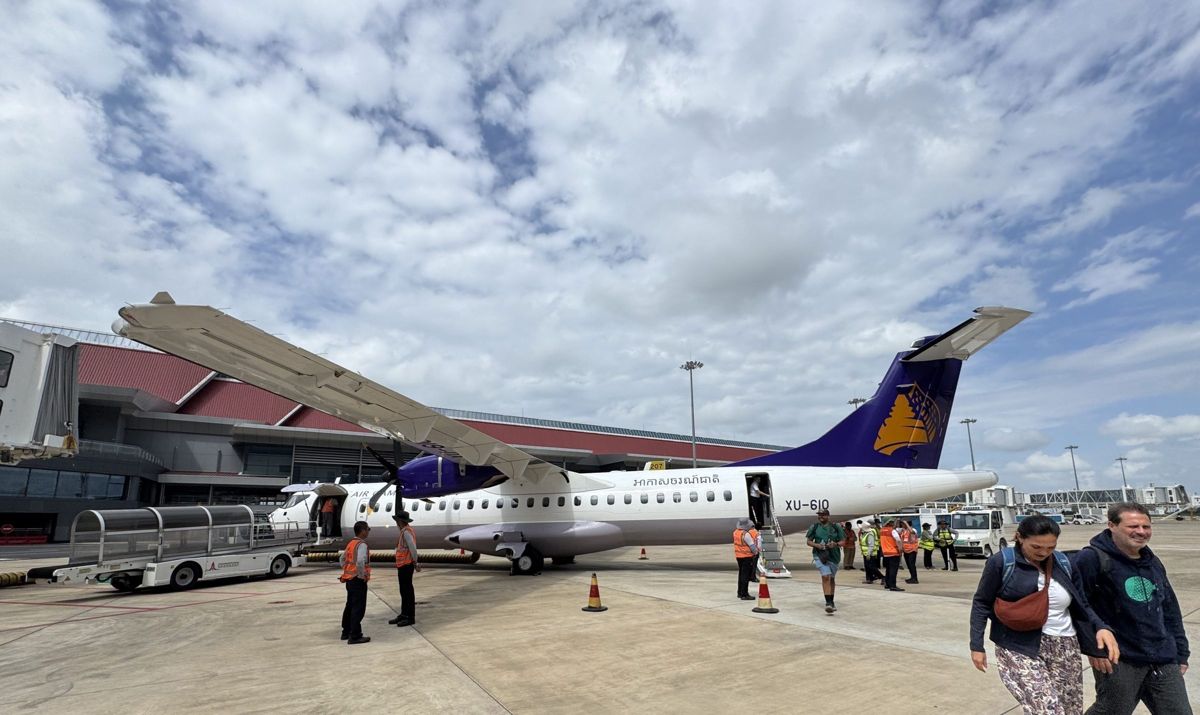
The new Siem Reap-Angkor International Airport, open since October 2023 and about 50 km east of town, has a single telecom counter for the three networks. A Siem Reap directory updated in October 2026 places it in the arrivals welcome area, about 20 m from the international exit, with Metfone, Cellcard and Smart side by side. It also mentions prepaid SIMs sold just outside the arrival hall.
The sequence that works:
- Clear immigration and collect bags.
- Go straight to the telecom counter before the taxi desk.
- Hand over the passport, choose the pack and let the seller insert and activate the SIM. Keep the plastic card with the number and the PIN.
- Test data by opening a map before leaving the counter.
- Then decide between the $35 fixed-fare taxi, the $8 airport shuttle and a ride-hailing car.
Working data at step 5 is what makes the choice real. The airport to city guide explains why ride-hailing pickups at the airport are unreliable and when the taxi is the better buy anyway.
No operator publishes the counter’s opening hours. Travelers on the last evening arrivals should not count on it being staffed, and should either buy an eSIM before flying or plan to buy a SIM in town the next morning.
eSIM: When It Is Worth It
International eSIM bought before the flight
The answer for a late arrival, a short connection or a phone with no SIM tray. Airalo, one of the widely used international eSIM sellers, cost $4.50 for 1 GB or $11 for 5 GB over 30 days in Cambodia in April 2026, according to a Siem Reap budget guide updated that month. The eSIM is installed at home over Wi-Fi and switched on when the plane lands. It needs an unlocked phone that supports eSIM. Most international eSIMs give data only, with no Cambodian number.
The limitation: 5 GB is a sixth of what $5 buys from Smart at the counter, and without a local number, drivers who work by phone call cannot reach you.
Local eSIM from a Cambodian network
Possible, but not the shortcut it looks like. Smart’s eSIM is bought through the SmartNas app or website with a passport scan, a face scan and Wi-Fi during the purchase. Cellcard’s is sold through its app or stores. Neither lists its Traveller SIM bundles as an eSIM product, so a visitor ends up on a local plan priced for residents, which takes more steps to set up than the five-minute airport counter.
Registration and the Passport Rule
Cambodia has required SIM registration for more than a decade. The Telecommunications Regulator of Cambodia set final registration deadlines in 2015 and 2016 and had operators deactivate unregistered numbers. Every SIM sold today is linked to an identity document, and for a visitor that is the passport.
In practice this means:
- Carry the original passport to the counter. A photo of it on your phone is not accepted for a new SIM.
- The number is registered to you. Do not buy a pre-activated SIM from a stranger outside the terminal, because you do not know whose name it is in.
- Smart’s registration includes a face scan, which it describes as biometric, and says approval is usually instant.
- A lost passport means a lost way to replace the SIM. Note the SIM’s number and keep the card it came on.
No 2025 or 2026 rule change for visitors was announced by the regulator or the operators as of November 2026.
Topping Up and Running Out
A Traveller SIM pack ends when its days or its data run out, whichever comes first. On a 15-day pack with 30 GB, data rarely runs out on a temple trip. Video calls home and uploading photos over mobile data are the heavy uses.
Top-up methods differ by network. Smart lists scratch cards with a code typed into the phone, online cards and mobile banking, and each operator has its own app for buying a new bundle. Ask the seller at the counter to show you the balance code for your network before you leave.
For payments, data matters beyond the map. The Bakong Tourists app from the National Bank of Cambodia lets a visitor pay KHQR codes at stalls without a Cambodian bank account, and it works only with a connection. Cash in US dollars still settles most bills, as the money guide explains.
Coverage at the Temples and Beyond
All three networks sell in Siem Reap town, and ride-hailing apps work there. No operator publishes a coverage map detailed enough to promise a signal inside a particular temple or on the Tonle Sap floating villages.
Two practical habits cover the gaps. Download an offline map of Siem Reap and the Angkor area before the first temple day. And agree a meeting point with the driver at each temple, by name and gate, instead of relying on a call. The tuk-tuk, car and bike guide has the circuits and the standard pickup points.
On longer day trips to Phnom Kulen or Beng Mealea, the road is long and the signal can drop between villages. Do not plan a ride-hailing car back from a remote temple. Hire the driver for the round trip.
By Situation
You have three to five days and an unlocked phone
Smart’s $5 Traveller SIM at the airport counter. It covers the Angkor Pass days, the maps, the ride-hailing apps and calls to a Smart driver, with data to spare.
You are in Siem Reap for one or two nights
Cellcard’s $5 three-day pack or Smart’s $5 pack, whichever counter is free. The price is the same and the allowance is more than enough.
You land on the last flight of the evening
Install an international eSIM before you fly. The counter may be closed, and the 50 km ride into town is easier with a map and a way to message the hotel.
Your phone has no SIM tray
An international eSIM bought at home. Local eSIMs exist but are priced and built for residents, and setting one up on arrival day takes longer than the counter.
You are traveling with a family
One Smart SIM per adult who will be out alone, and none for the children. Most phones can share data through a hotspot, so a single $10 premium pack with 60 GB covers a family on the same tuk-tuk all day. The Siem Reap with kids guide has the rest of the family logistics.
You are traveling on to Phnom Penh or Bangkok
A Smart or Cellcard SIM works across Cambodia, so one pack covers the rest of the trip. For Thailand, buy separately, because the land border has been closed since June 2025 and the only route is by air, as the Bangkok to Siem Reap guide explains.
What It Actually Costs
| Option | Price | Data and validity | Calls and number | Where |
|---|---|---|---|---|
| Smart Traveller SIM, standard | $5 | 30 GB, 15 days | 300 min Smart-to-Smart, 30 min other networks or abroad, local number | Airport counter |
| Smart Traveller SIM, premium | $10 | 60 GB, 30 days | 600 min Smart-to-Smart, 40 min other networks or abroad, local number | Airport counter |
| Cellcard Traveller SIM | $5 | 3 GB, 3 days | 30 min, local number | Airport counter, Cellcard stores |
| Cellcard Traveller SIM | $7 | 7 GB, 7 days | 70 min, local number | Airport counter, Cellcard stores |
| Cellcard Traveller SIM | $12 | 15 GB, 15 days | 150 min, local number | Airport counter, Cellcard stores |
| Cellcard Traveller SIM | $20 | 30 GB, 30 days | 300 min, local number | Airport counter, Cellcard stores |
| Metfone tourist SIM | On request ($5 to $8 in 2026 guides) | Varies | Local number | Airport counter |
| Airalo eSIM, Cambodia | $4.50 or $11 | 1 GB or 5 GB, 30 days | Data only, no local number | Online, before travel |
What is not included: the time at the counter, usually a few minutes, and a phone that is unlocked. A carrier-locked phone will not take any Cambodian SIM. Roaming on a home plan is the costly alternative, and its daily rate is set by the home carrier, not by anyone in Cambodia. A Cambodian SIM is paid in US dollars, and change under $1 comes back in riel at about 4,000 to the dollar.
What Other Guides Get Wrong
- Old price tables. The most-copied tables give Smart’s tourist pack as 25 GB for seven days or 5 GB for a week. Smart’s own page in November 2026 says $5 for 30 GB over 15 days.
- “Buy it in town, the airport overcharges.” At the airport counter the Traveller SIMs are the operators’ own products at their published prices. The real argument for town is a late arrival, not price.
- “Any SIM from the street works.” Every Cambodian SIM is registered to a document. A SIM sold activated by a stranger is registered to someone else.
- “eSIM is always easier.” An international eSIM is easier on arrival day. A local Cambodian eSIM needs a passport scan, a face scan and Wi-Fi during setup, and the cheap Traveller bundles are not sold that way.
- “Unlimited calls.” The large call allowances are for calls inside the same network. Calls to another network or abroad use a small separate allowance.
- “Signal everywhere at Angkor.” Town and the main circuits are covered, but no operator publishes coverage by temple. Offline maps and agreed meeting points are still the reliable plan.
Addresses, hours, prices and transport times checked against operator websites and official sources in November 2026. Hours change seasonally and prices change often. Confirm anything time-critical with the operator.
Where to Go Next
The SIM is the first purchase of the trip, and the second is the ride into town, covered in the Siem Reap airport to city guide with the taxi, the shuttle and the ride-hailing options. The getting around guide explains PassApp and Grab once you are in town. For the paperwork before landing, the Cambodia visa and e-Arrival guide has the official sites, and the daily budget guide puts the $5 SIM next to everything else the trip costs. A first visit is easier with the first-time Siem Reap guide open on the phone you just connected.
Addresses, hours, prices and transport times checked against operator websites and official sources in November 2026. Hours change seasonally and prices change often. Confirm anything time-critical with the operator. Found an error? Tell us and the guide's review date will be updated.
Frequently Asked Questions
What is the best SIM card for tourists in Cambodia?
For most visitors to Siem Reap, Smart's Traveller SIM is the simplest value. Smart's own plan page lists $5 for 30 GB, 15 days, calls to other Smart numbers and a small allowance for other networks, and $10 for 60 GB over 30 days. Cellcard's Traveller SIM is a good choice for a short stay, at $5 for 3 days or $7 for 7 days, but costs more per gigabyte. Metfone publishes no tourist price online. All three sell at the same airport counter and all three need your passport.
Can I buy a SIM card at Siem Reap airport?
Yes. A telecom counter in the arrivals area of Siem Reap-Angkor International Airport, about 20 m from the international exit, sells Metfone, Cellcard and Smart SIMs, according to a Siem Reap directory updated in October 2026. Smart states that its Traveller SIM is sold at its booth at any international airport in Cambodia. Bring the passport you entered on, because the SIM is registered to it before it is activated. Expect a short queue when two flights land together.
Do I need a passport to buy a SIM card in Cambodia?
Yes. Cambodian law requires every SIM to be registered to an identity document, and for a foreign visitor that means the passport. The seller scans it and links the number to it. Smart's registration process also takes a face scan, which it describes as biometric verification and says is usually approved instantly. A photocopy or a photo of the passport is not enough at an airport counter. A hotel cannot buy a SIM on your behalf with its own documents.
Does an eSIM work in Cambodia?
Yes, on an unlocked phone that supports eSIM. There are two routes. An international eSIM, such as Airalo, is bought and installed at home and starts working on landing. It cost $4.50 for 1 GB or $11 for 5 GB over 30 days in April 2026. A local eSIM from Smart is bought through the SmartNas app, the Smart website or a Smart shop, with a passport scan and a face scan, but Smart lists no tourist eSIM package, so the cheap Traveller SIM bundles are a physical-SIM product.
Is Wi-Fi enough in Siem Reap without a SIM?
In town, mostly. Hotels, guesthouses and most cafés and restaurants offer Wi-Fi. The problem is everything between them. Calling a PassApp or Grab tuk-tuk from a temple car park, finding a driver who is waiting at a different gate of Angkor Wat, or paying with the Bakong Tourists app at a stall all need data on the spot. For a three-day temple trip, a $5 SIM costs less than one wasted tuk-tuk ride.
Should I buy the SIM at the airport or in town?
At the airport, for most travelers. The Traveller SIM prices are the operators' own published prices, and the counter is on your way out. Having data before leaving the terminal means a ride-hailing car is an option, not only the $35 taxi, and messages to a hotel or a driver go through. Buy in town only if you land late and the counter has closed, or if your plan is a long stay and you want a regular monthly plan from an operator's shop.
More Getting There & Around guides
Start with the pillar guide: Siem Reap-Angkor International Airport to the City: Taxi, Bus, Prices and the 50 km Problem (2026).
-
-
-
-
-

-